
Introduction
You just sent a Shah Rukh Khan reaction still from Om Shanti Om to your college group chat. Your friend replied with the “Distracted Boyfriend” meme. Someone else dropped a “Rasode Mein Kaun Tha” remix song made by Yashraj Mukhate. And then another friend of yours who is a big fan of Hera Pheri sent Akshay Kumar’s smile GIF. Nobody asked for any consent or permission or paid a rupee to use these templates. So here’s the question nobody in that chat is googling or searching: Is posting memes copyright infringement in India?
Short answer? Technically, it often can be. Practical answer? It depends on what you post, where you post it and why. Let’s break all this down and simplify.
1. The Uncomfortable Truth: Most Meme Templates Belong to Someone
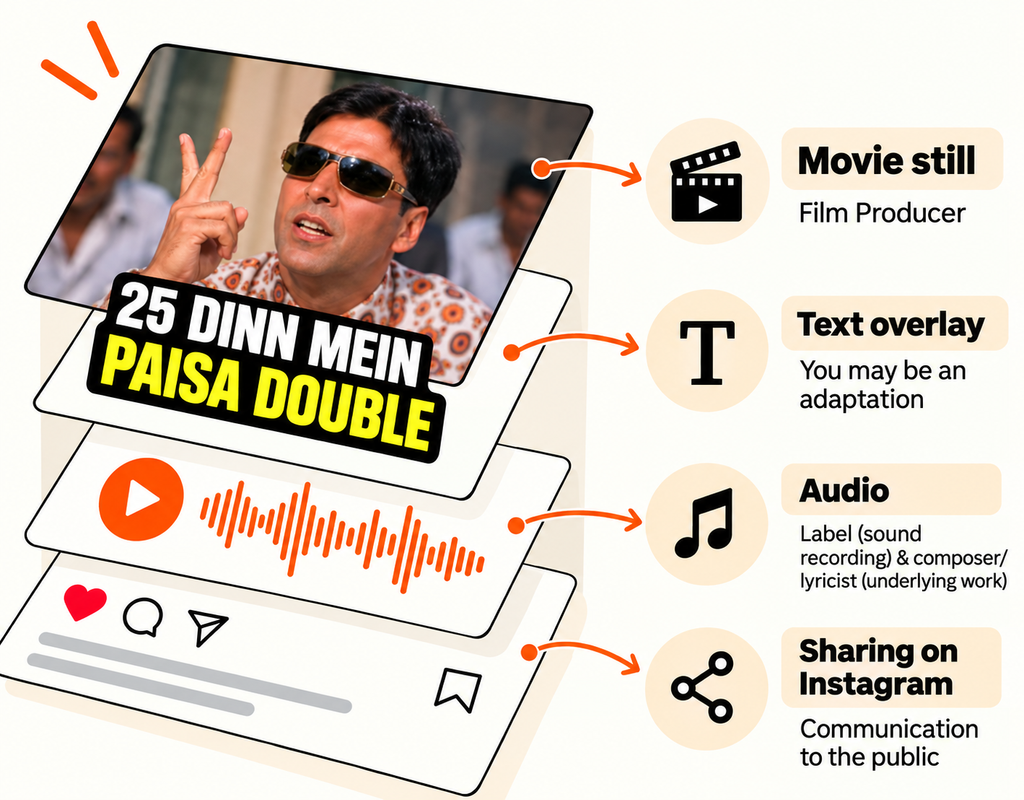
Image 1: Infographic breaking a meme into layers (film still, text overlay and audio) with the rights owner labelled for each layer.
Memes feel like they belong to the internet. Legally, they don’t. Under the Copyright Act, 1957 (‘the 1957 Act’), copyright exists in original literary, dramatic, musical and artistic works, films and sound recordings. Nothing in that list says the fact that “unless it’s funny”.
Break a typical meme into its raw ingredients and you will find at least two owners hiding in it:
| Ingredient | Likely Owner |
| Movie or web series still | Film Producer |
| Stock photo (Distracted Boyfriend, for instance) | Photographer or stock agency |
| Audio in a Reel | Label owns the sound recording and composer/lyricist owns the underlying work |
| Cartoon or illustration | Audio or studio |
| Screenshot of someone’s tweet/x post | Author of the tweet, if it clears the originality bar |
Here’s the part people miss. A film’s copyright owner has the exclusive right to make a photograph of any image from the film.1 So screenshotting that iconic Hera Pheri scene is on paper making a copy since you did not record the film, did not upload it or took one frame. That shall still infer as reproduction.
Now layer on what shall happen next. Adding your own caption on top may count as an adaptation and sharing it on Instagram is communication to the public. That is three exclusive rights in one post that took you thirty seconds to make.2 Doing any of this without a permission is infringement under Section 51.3
2. Panic Later. Meet ‘Fair Dealing’.
Before you delete your camera roll, meet Section 52 of the 1957 Act, which lists acts that are not infringement. Three of them matter for memes:
- Private or personal use, including research
- Criticism or review
- Reporting of current events and current affairs4
Now the distinction that trips up almost every Indian law student who learnt copyright from American YouTube videos. Indian law differs from US law here. The US has open-ended “fair use”. It is a four-factor test where a judge weighs purpose, nature, amount and market effect.5 Any purpose can qualify if the factors line up.
Whereas, India has “fair dealing”, which is a closed list. If your use does not fall within a listed purpose, you do not get to argue it was fair anyway. “But, I wasn’t making money” is not a valid defense since the argument is about damages not liability. With those listed purposes, Indian courts weigh how much of the copyrighted content you took, why you took it and whether you have damaged the owner’s market. The Delhi High Court’s approach in the Rameshwari Photocopy (DU photocopy)6 case is a useful anchor. The Court read the exception purposely rather than grudgingly by refusing to treat every act of copying as presumptively wrong.
So, is parody protected?
There is no standalone parody exception in the 1957 Act. However, courts have been willing to parody as a form of criticism.
In Civic Chandran v. Ammini Amma7, the Kerala High Court examined a counter drama that lifted characters, situations and dialogue from a well-known Malayalam play in order to attack its politics. The court refused an injunction, reasoning that the purpose was criticism and that the counter-drama was not competing with or substituting for the original.
The takeaway for memes is sharper than it looks. A meme that comments on the source or uses the source to comment on something else has a real argument. A meme that simply reposts a funny clip because “it’s funny” is just reproduction with a caption on it.
So, just ask yourself: If a judge asked “what is this post criticising?”, would you have an answer?
3. The Real Risk Meter: Personal Post v. Brand Post
Let’s be honest. No producer shall be suing a 19 year old over a WhatsApp sticker. Enforcement follows money and the exposure climbs steeply the moment a meme starts earning. Here’s a risk analysis and bifurcation:
| Scenario | Risk | Why |
| Meme in a private group chat | Low | Personal use, no market harm |
| Personal Instagram meme about a news event | Low to moderate | Plausible criticism or current-events argument |
| Meme page running ads and brand collaborations | Moderate | You are monetising someone else’s work |
| Brand using a film still for moment marketing | High | Commercial, no listed purpose or lack of consent and implied endorsement |
| T-shirts, mugs or stickers with meme characters | Very High | Straight commercial exploitation and merchandising rights |
Globally, cautionary tales come from brands. In the US, the owners of Grumpy Cat brand won around USD 710,000 against a US beverage company that used the cat’s image beyond its licence.8 The lesson to learn here is that virality does not convert a protected work into free meme stock. If you are advising a social media team, that table is the whole conversation.
4. Plot Twist: Copyright is only half the problem
- Personality rights: Most Indian memes feature real and famous faces. In Anil Kapoor v. Simply Life India, the Delhi High Court restrained others from misusing the actor’s name, image, voice and catchphrase “jhakaas”, including GIFs, morphed images and deepfakes for commercial purposes.9 The Bombay High Court protected singer Arijit Singh against AI voice cloning.10 Satire and news generally remain safe, but using a star’s face to sell your product does not.
- Trademarks: Putting a brand logo in a meme for laughs is usually fine, since trademark infringement needs use of the trademark in the course of trade11. If your brand’s meme suggests a tie-up with another brand or disparages it, though, you are in risky territory.
- Takedowns: Rights holders rarely sue meme accounts. They file takedown notices via the social media platform where such content is posted. Platforms usually comply so they keep their safe harbour protection.12 Repeated strikes can cost you a meme page and disable an account on repeated strikes as well.
5. Your Meme Hygiene Checklist
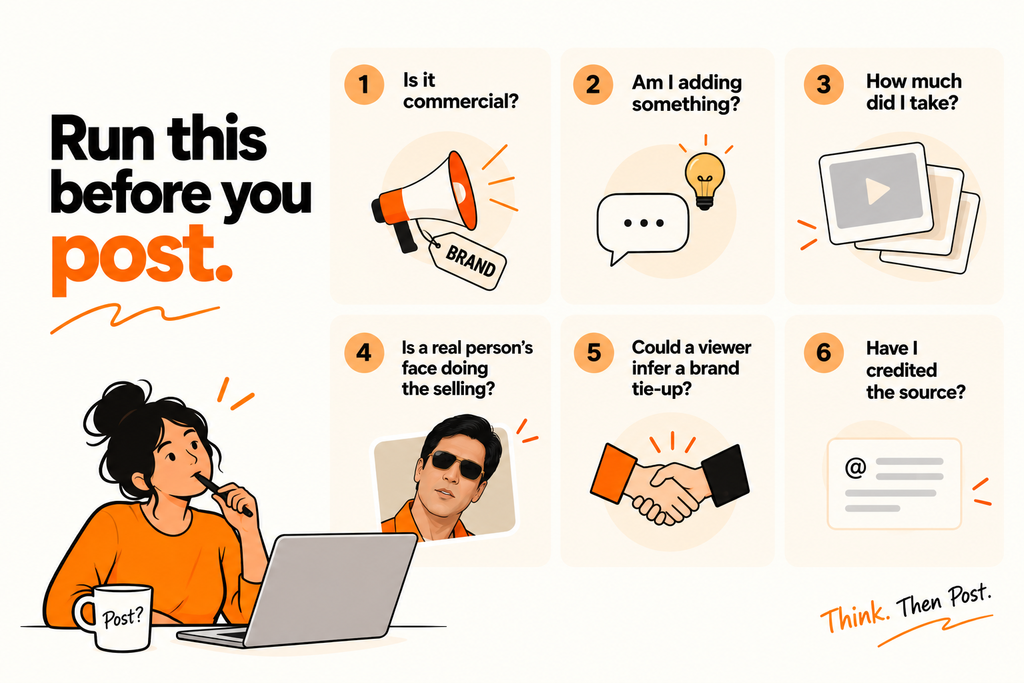
Image generated by OpenAI
Run this before you post or before you sign off on a client’s post:
- Is it commercial? If a brand, sponsor or product is anywhere near it, use licensed or original templates.
- Am I adding something? Commentary, critique or parody beats plain reposting.
- How much did I take? One still is defensible. A forty-second clip is not.
- Is a real person’s face doing the selling? That is personality rights, separate from copyrights.
- Could a viewer infer a brand tie-up? If yes, redo it.
- Have I credited the source? Credit doesn’t cure infringement, but it shows good faith and respects the author’s moral rights under Section 57.13
The Takeaway
Posting memes is not automatically illegal, but it is not automatically free either. Personal and commentary driven are usually safe. Commercial memes built on someone else’s film, photograph or face are where notices, strikes and suits live.
If you want to advise creators and brands on this, you need to know how fair dealing is argued, how licences are drafted and how personality rights claims are built. That’s what we cover in our Mastering IPR & TMT course and our Intellectual Property: Law & Practice course.
Want to build a career in IP law? Book a free call with a Lawctopus Law School counsellor or explore our courses here.
Disclaimer: This article is for informational purposes only and does not constitute legal advice.
References
- The Copyright Act, 1957, No. 14 of 1957, Section 14(d)(i)(A) (India). ↩︎
- The Copyright Act, 1957, No. 14 of 1957, Section 14 (India). ↩︎
- The Copyright Act, 1957, No. 14 of 1957, Section 51 (India). ↩︎
- The Copyright Act, 1957, No. 14 of 1957, Section 52(1)(a) (India). ↩︎
- Rich Stim, Measuring Fair Use: The Four Factors, Stan. Uni. Libra.: Copyright & Fair Use, https://fairuse.stanford.edu/overview/fair-use/four-factors/ (Sep 11, 2026, 7:08 PM). ↩︎
- Chancellor, Masters & Scholars of the Uni. of Oxford v. Rameshwari Photocopy Servs., (2016) 160 DRJ 678 (India). ↩︎
- Civic Chandran v. Ammini Amma, (1996) 16 PTC 670 (India). ↩︎
- Steve Brachmann, Grumpy Cat Wins $710,000 Verdict for Copyright, Trademark Infringement Against Beverage Maker, IPWatchDog, https://ipwatchdog.com/2018/01/27/grumpy-cat-wins-copyright-trademark-infringement/ (Sep 11, 2026, 11:21 PM) ↩︎
- Anil Kapoor v. Simply Life India, 2023 SCC OnLine Del 6914 (India). ↩︎
- Arijit Singh v. Codible Ventures LLP, 2024 SCC OnLine Bom 2445 (India). ↩︎
- The Trade Marks Act, 1999, No. 47 of 1999, Section 29 (India). ↩︎
- The Information Technology Act, 2000, No. 21 of 2000, Section 79 (India). ↩︎
- The Copyright Act, 1957, No. 14 of 1957, Section 57 (India). ↩︎
About the Author
Aarushi Relan is an Intellectual Property and Technology Law practitioner with 5+ years of experience. She holds a B.Com. LL.B. (Hons.) from Amity University and an LL.M. in International IP and Technology Laws from the University of Cambridge. She is currently a Learning Manager at Lawctopus Law School, specialising in Trademarks, Copyright and Technology Law.