
Imagine being in your internship and opening a commercial contract for the first time and it’s 100 pages. That 100 pages are loaded with legal jargons that makes you wonder if you ever paid attention in your contract law lectures. Or, maybe you are a young lawyer trying to explain the clauses to a client in a lucid manner but unable to understand the clauses yourself.
If you are a law student or a young lawyer, you first need to be familiar with the terms which tell you what the parties are agreeing on, what they are promising and what has to be done before the contract can move further.
These are 5 provisions every law student or young lawyer should understand in a commercial contract.
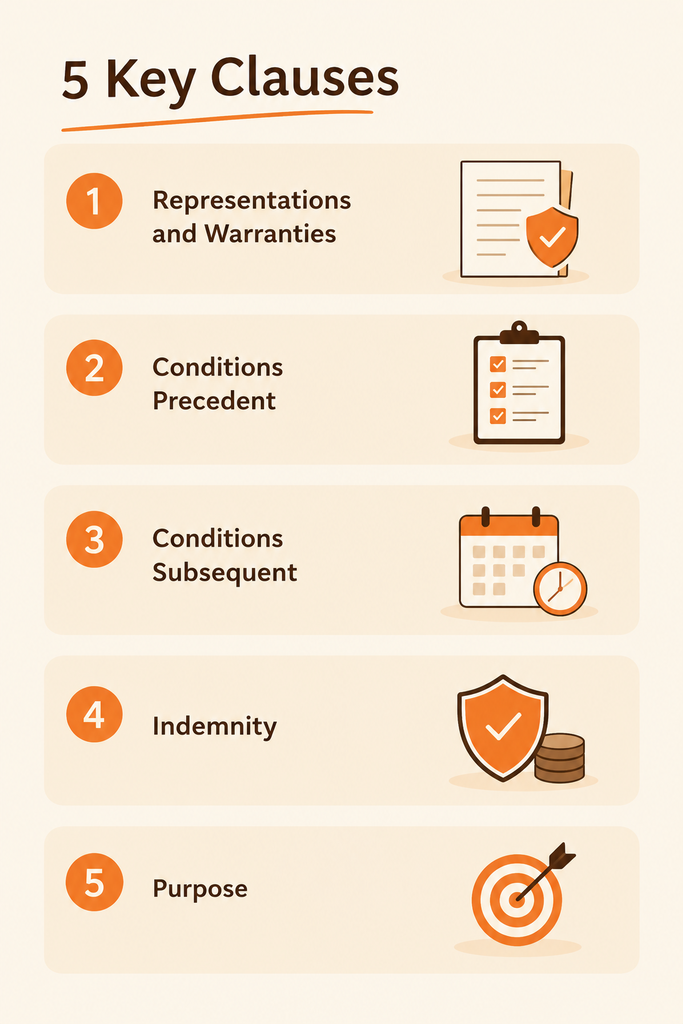
Image 1: Five key clauses every law student should know when reviewing a commercial contract.
1. Representations and Warranties – you should believe this and it is real
Representations and warranties are statements made by one party to a transaction to the other party relating to particular facts, events or conditions. They are significant in transactions where one party is depending on information supplied by the other before engaging into the deal.
A representation is a statement of fact made by a party, while a warranty is a promise that the stated fact is true and will remain so. Hence, you can understand this as representation states a fact, while a warranty guarantees that the fact is true.
For example, Company Y will be bought by Company X. Company X needs to know whether Company Y truly owns the assets it claims to and that there are no legal problems tucked away that might suddenly be discovered. Company Y may include a paragraph in the agreement indicating it has good and marketable title to the relevant assets, that the Company has followed with applicable laws and that the financial statements presented to the buyer are correct in all material ways.
This is important since the buyer is making a decision to buy based on these assertions. If the seller asserts that there is no material litigation and the buyer discovers after the purchase of the company that the company was already subject to a material claim, the buyer may have contractual remedies in accordance with this clause.
2. Conditions Precedent – these are things that must be done before we close
A commercial deal may be signed on Monday but not fulfilled for weeks or months. Why? Because there are several things that may need to happen before the parties go through the transaction. These are often referred to as Conditions Precedent or CPs.
For example, a company has agreed to buy another company. The parties may have signed the share purchase agreement but completion may be subject to conditions such as regulatory clearances, third-party consent or a specified corporate activity. The parties may not be obligated to continue to close until the stipulated criteria are met or waived.
Therefore, CPs are of particular importance in transaction papers. They tell you what has to happen before the parties can get to conclusion.
3. Conditions Subsequent – The agreement has happened but there are still conditions which can still change things
Conditions Subsequent (CS) are conditions that need to be fulfilled after the agreement is executed. In most agreements, CP must be fulfilled before an obligation starts, while a CS must be fulfilled after the agreement is executed.
Suppose Company A engages Company B to offer certain services for 3 years. The agreement is dependent on a particular regulatory licence held by Company A to deliver those services. If the licence is canceled, so does the agreement. The cancellation of such licence takes place after the agreement has entered into force but has a contractual effect on the parties.
4. Indemnity – to hold someone harmless
No business enters into a transaction expecting everything to go smoothly. One reason they negotiate contracts is to work out who will pay for things if they go wrong. One of the primary contractual tools for this goal is an indemnity.
For example, Company A acquires Company B. Then, 6 months after the purchase, a tax authority issues a demand for a period prior to the acquisition. The liability may fall on Company A as the new owner. But the parties may have agreed in their acquisition agreement that the seller will compensate the buyer for certain pre-closing tax liabilities.
So the indemnity clause would read something like this: If a certain tax liability is incurred for a period prior to closure, the seller shall indemnify the buyer for any loss incurred, subject to the agreed terms and limitations.
5. Purpose – the reason of doing a transaction
The purpose clause may not appear as daunting as an indemnification or representations and warranties provision but it can be a helpful beginning place when reviewing a contract.
For example, you’ve been handed a 50 page technology services contract. Before you get into pages of detailed commitments you should know what the parties are really trying to accomplish. Is one party giving software to the other? What business function is the organization outsourcing? Is the producer offering his product to a distributor?
Of course, these are not the only clauses a lawyer has to know. The contract will contain clauses dealing to termination, limitation of liability, confidentiality, dispute resolution, governing law, force majeure and intellectual property which may all be of equal importance. But these are simply the 5 clauses one must know to start with.
From Reading Contracts to Actually Drafting Them
The next time you come across a 40-page commercial contract, don’t let the length or legal jargon intimidate you. Instead, ask:
What is the deal? What are the parties promising? What needs to happen before the deal can go ahead? What happens if something goes wrong? And who bears the risk?
These questions give you a practical lens for reading and understanding contracts. And once you become comfortable identifying the purpose and function of individual clauses, the next step is learning how those clauses are actually drafted, reviewed and negotiated.
Because in practice, knowing what an indemnity or condition precedent means is only the beginning. A lawyer also needs to know how to frame the clause, spot problems in an existing contract, and negotiate language that protects the client’s interests.
If you want to take that next step, Lawctopus Law School’s Contract Drafting and Negotiation Course is designed to help law students and young lawyers build exactly these practical skills.
The course covers the fundamentals of contracts, drafting of agreements and operative clauses, contract review, clause redrafting, and practical exercises such as the Contract Lab and Negotiation Table.
So, if your goal is to move from “I understand this clause” to “I can actually work with this clause”, this is a skill worth developing.
About the Author
Simran Sabharwal is a Gold Medallist in Business Laws from RGNUL, Punjab, and a former Associate at Khaitan & Co. She is currently a Learning and Editorial Manager (Corporate Vertical) at Lawctopus Law School, where she teaches corporate law and practical commercial drafting.