
Six of the precedents relied on were invented. Not misread or distinguished badly but did not exist. This happened recently in National Company Tribunal Matter (‘NCLT’) matter where during the tribunal hearings, there were multiple non-existent and fake judgments relied upon.
In July 2026, the Supreme Court (‘SC’) set both orders aside and held a decision that resting on a hallucinated authority is no decision at all. Further, SC directed Bar Council of India (‘BCI’) to frame rules and prescribe disciplinary consequences for advocates who do the same.1
This settles the question most partners were quietly asking. Not whether the team should use Artificial Intelligence (‘AI’), as they already do. The real question to ask is what AI skills do lawyers need now that the SC has put verification burden squarely on the signing advocate. Four skills and none of them require learning how to code.
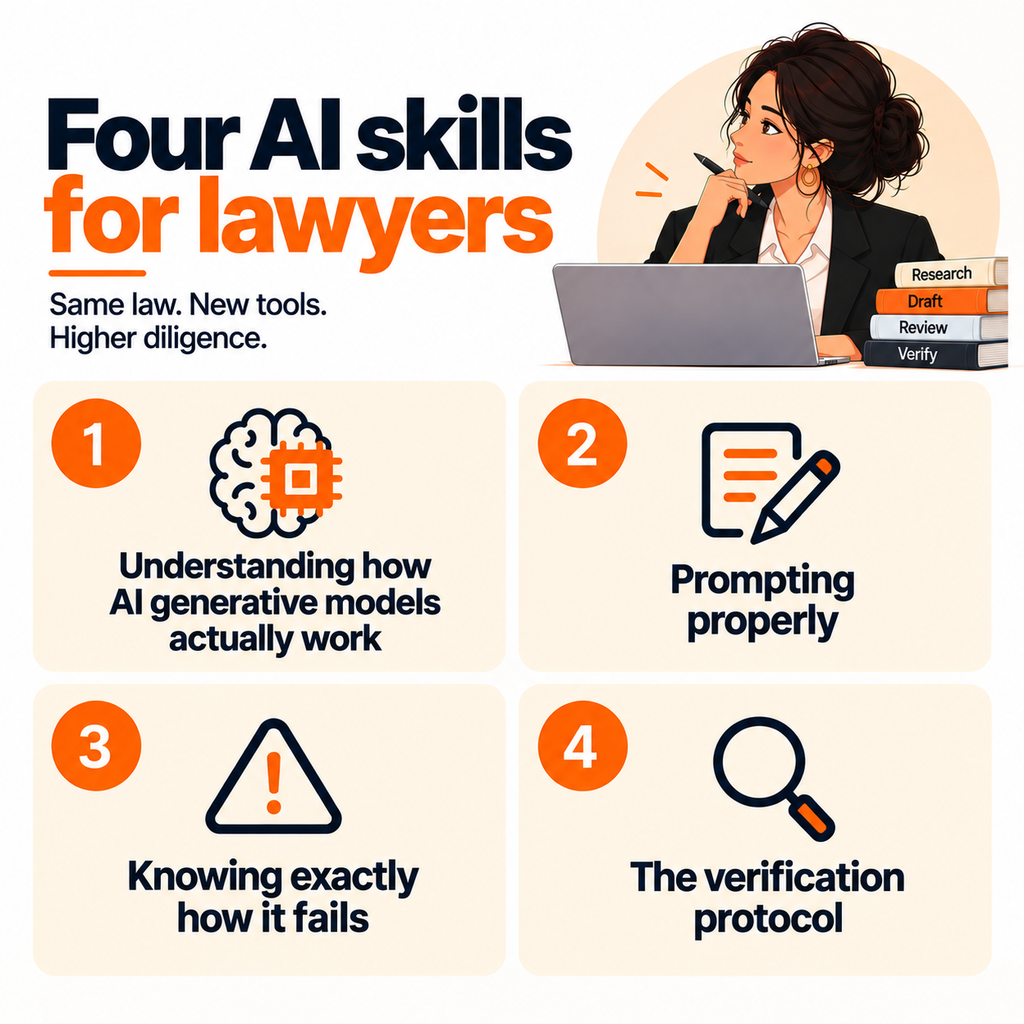
Image 1: Four AI Skills for Lawyers
Skill I – Understanding how AI generative models actually work
A Large Language Model (‘LLM’) predicts plausible text. They are a category of deep learning models which are trained on immense amounts of data making them capable of generating natural human-like language.2 LLMs are strong at drafting and summarizing because both are structural tasks. It is built to sound right rather than to be right, which is why a fabricated citation arrives with exactly the same confidence as a correct one. The outputs are also non-deterministic and change if you run the same prompt twice. It is likely that you will receive a slightly different answer the second time.
Two consequences follow immediately for Indian law practitioners. Firstly, confidential client material and information should not be pasted into consumer tools. For instance, pasting an unexecuted share purchase agreement into a free chatbot is a privilege problem and also engages the Digital Personal Data Protection (DPDP) Act, 2023.3 The lawyer remains in charge and the tool is a support system for judgment, not a substitute for it. You supervise it and you own the work product. To understand this concept further, please read.
Skill II – Prompting properly
Prompting an AI tool is the highest leverage skill in this whole area and it is the one most senior lawyers skip because it sounds like a trick. The golden rule in prompt is an unglamorous one. Quality in equals quality out, and a vague prompt produces a vague answer.4 A reusable structure of a prompt mostly has six layers and most weak prompts miss few of these:
- System context – Who the AI is, the domain, the objective, the rules, such as “You are an experienced IP professional advising on a litigation ready draft of a mutual NDA.”
- Input context – The background, facts and source material. Paste the indemnity clause or Section 138 notice it must work from.
- Role and tone – Senior advocate, in-house compliance officer, plain language explainer for a lay client or formal tone draft to be filed before the High Court of Delhi. Each framing produces a different output.
- Task instruction – AI model must be briefed exactly what to do such as summarize, draft, review, compare and argue. An instruction such as “Compare these two force majeure clauses and list every difference in risk allocation.” One clear task beats five vague ones.
- Output specifications – Format, length, tone and citation style needs a clear mention. A 200-word note to the client, a clause-by-clause table and a draft of Trademark Infringement Legal Notice should be captured in the prompt.
- Prompt strategy – Ask it to reason step by step, self-check and flag anything it is unsure about before finalising. It is also necessary to put guardrails or source constraints within your prompt strategy such as “Don’t assume facts and generate an output based on the instructions or facts.”
Add the missing layers to a prompt you already use and the output changes completely. This is a craft, learnable in an afternoon and can be improved over months.
Skill III – Knowing exactly how it fails
Generic warnings about hallucinations are useless in practice. The failure modes in legal research are specific and you can supervise against each one. Firstly, an AI model is capable of inventing an authority such as fabricated case names, wrong citations, mixed-up bench strengths, misquoted lines from a judgment, invented paragraph numbers and other specifications important for legal research and analysis. There has been an emergence of what is called as Phantom Precedents where a judge reviewing the matter attempts to locate the ratio only to discover the case is a phantom.5
Secondly, the AI models cannot infer what you withheld. Feeding the model half a paragraph or a cherry-picked quote and it will fill the gaps by guessing the facts and the reasoning. Giving it only the operative part of an award and it will invent the tribunal’s finding on limitation. The models struggle with long judgments which routinely run in hundreds of pages. Context retention degrades, annexures get skipped and facts established early are forgotten by the end. It also lags in current law, so unless the text is fed or retrieved, it does not know recent amendments or decisions.6 With the recent criminal codes being replaced and the DPDP Act rules still settling in, this gap is currently wide and moving.
The working habit of a practising lawyer must be to question the output like questioning a junior or intern’s work such as, “Where is this written?”, “Which case and paragraph?”, etc. Never let AI output travel forward uncited.
Skill IV – The verification protocol
It is a myth for institutions and individuals to treat verification as a friction that shall slow the process of work. An AI model can produce false positives, false negatives or even hallucinate. The mechanisms for catching their failures are equally important and part of the system.7
This is the part worth laminating. Four necessary checks before you trust any AI-generated citation are:
- Does the case exist? Running the name through SCC Online, Manupatra, High Court or SC website is important. No result would infer that the case does not exist.
- Does the citation match? Confirm the year, volume and page point to that case in the official record.
- Is the holding real? Open the judgment and confirm the proposition, any quoted line that AI model states appears in the case.
- Right bench and date? Verify who decided it and when. A small error here can point to a completely different case.
Four checks, a few minutes each and they run in order. A failure at step one makes other steps unnecessary. This is also the review protocol to hand your juniors because it converts a vague instruction into something auditable. Note that the last two steps are the ones lawyers mostly skip and they are ones that catch the padded judgment problem. A real case with an invented paragraph passes checks one and two comfortably.
Pick one recurring task such as a client advisory email or a general NDA draft that happens quite often in your workplace. Run it through a properly layered prompt, then run the output through the four necessary steps. Time both the routes and then ask your junior colleagues what they are already using. The answer will be more interesting than you expect. Sharing what you are learning in AI and law helps one grow faster.
If this article interests you, please check Lawctopus Law School’s 3-month course on AI for Legal Professionals. It covers prompt engineering, verification workflows, legal research and drafting skills necessary for practising lawyers. Book a call with a counsellor to find the right fit.
Disclaimer: This article is for informational purposes and does not constitute legal advice.
- Pooja Ramesh Singh v. Jammu & Kashmir Bank Ltd., 2026 INSC 668 (India). ↩︎
- Cole Stryker, What are large language models (LLMs)?, IBM (Sep 4, 2026, 4:05 PM), https://www.ibm.com/think/topics/large-language-models. ↩︎
- The Digital Personal Data Protection Act, 2023, No. 22, Acts of Parliament, 2023 (India). ↩︎
- Harvey Team, AI Prompting Best Practices for Lawyers: Getting Better Outputs, HARVEY (Sep 4, 2026, 6:21 PM), https://www.harvey.ai/blog/ai-prompts-for-lawyers. ↩︎
- Himanshu Mishra, Phantom Precedents: The Rise of AI-Generated Case Law in Indian Courts, Live Law (Sep 5, 2026, 8:05 AM), https://www.livelaw.in/articles/phantom-precedents-ai-generated-case-law-indian-courts-526665. ↩︎
- Jerrin B. Mathew et al., The Disadvantages and Limitations of Using Large Language Models in the Field of Law, NATIONAL LAW SCHOOL OF INDIA UNIVERSITY, BENGALURU (Sept 5, 2026, 12:21 PM) https://www.nls.ac.in/research/projects/the-disadvantages-and-limitations-of-using-large-language-models-in-the-field-of-law/. ↩︎
- Tshilidzi Marwala, The “Doubt and Cross-Validate” Protocol: Why We Must Always Question AI, UNITED NATIONS UNIVERSITY (Sep 5, 2026, 1:05 PM) https://unu.edu/article/doubt-and-cross-validate-protocol-why-we-must-always-question-ai. ↩︎
About the Author
Aarushi Relan is an Intellectual Property and Technology Law practitioner with 5+ years of experience. She holds a B.Com. LL.B. (Hons.) from Amity University and an LL.M. in International IP and Technology Laws from the University of Cambridge. She is currently a Learning Manager at Lawctopus Law School, specialising in Trademarks, Copyright and Technology Law.