
Picture this scenario- You are about to acquire a company. Not just a small acquisition- a $11 billion-deal. And your background check on them is around six hours. That’s it. That is literally what happened when Hewlett-Packard bought British software startup Autonomy in 2011.1
A year later HP figures out the math doesn’t work up, the “revenue” wasn’t quite what it seemed, and they write down $8.8 billion of the deal – basically admitting they got tricked. This entire mess was dragged in courts for nearly a decade.2 So to draw a simple analogy: Due diligence is the corporate version of stalking someone’s instagram page before agreeing for the third date. Except when you choose to skip it here, the red flags can cost billions, not just a bad Hinge match.
Way Beyond M&A: Where Due Diligence Actually Lives
Most people hear “due diligence” and think it’s just an M&A tick box. Not even a little bit. Due Diligence (“DD”) is the background check engine quietly humming behind practically every deal when real money changes hands on someone else’s word.
Consider it a habit that appears anywhere trust needs to be verified, rather than a one-time formality.
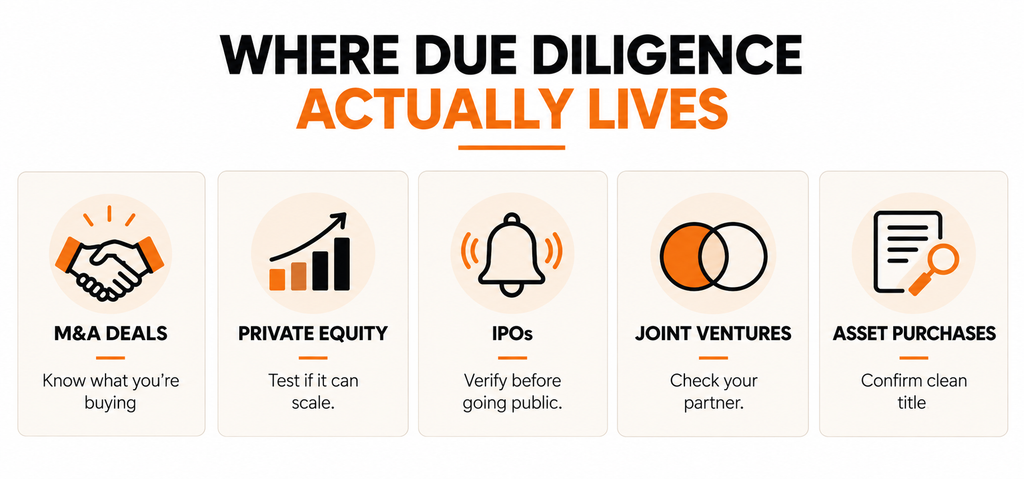
Image generated using Perplexity AI
- M&A deals– the classic scenario, we all know about it. You’re purchasing a whole company so you had better be damn sure about what you’re buying before you hand over that big fat check.
- Private equity deals– investors use DD to evaluate whether a business can really scale the way the pitch deck promises or whether the growth projections are cooked up.
- Initial Public Offerings, or IPOs– Before a business goes public, merchant bankers and lawyers comb through every financial statement and disclosure to make sure nothing is hidden. Miss something here and it’s not simply an inconvenient mistake – it can create securities fraud liability once the company’s stock is trading.3
- Joint ventures– you’re starting a long-term partnership with another business, so DD looks into if your new “partner” is financially sound, operationally reliable and not secretly sitting on problems they haven’t been disclosed.
- Asset purchases– even buying a single item like property, IP, or equipment needs DD to ensure the seller genuinely owns it, free and clear of any hidden liens or claims attached.
If HP had done this kind of inspection, the kind PE investors or IPO lawyers do as a matter of course, not a six hour skim, they might have detected Autonomy’s accounting difficulties before the money left the building, not after.
The Real Payoff: DD Doesn’t Just Warn You, It Rewrites the Deal
This is the aspect that makes due diligence powerful, not merely cautious: whatever it uncovers becomes something you can negotiate on. DD isn’t just about whether to walk away- it directly influences the deal you end up signing.
This is where representations and warranties come into play. Reps are true claims the seller makes about the company- the financials are correct, the company owns its assets, taxes are filed and there’s no pending litigation. Warranties are the seller’s guarantee that these facts remain true. They are what the buyer can actually enforce later on if the reality does not match what was advertised. And DD is what says which of those promises you need to worry about.
Discovered some litigation risk in due diligence? That gets carved into a special indemnity clause. Got exaggerated revenue numbers? That’s leverage to haggle the purchase price down. Worried the seller might disappear after closing? That’s when buyers ask for an escrow, often 5 to 10 percent of the purchase price held aside for 12 to 24 months to cover any of these claims proving untrue.4 Some purchasers skip the escrow fight entirely and purchase representations and warranties insurance, which transfers the financial risk to an insurer instead of chasing the seller for money after the deal has already completed.
None of this exists without due diligence first. You can’t negotiate protection against a risk you never found.
Bottom Line: Trust is Expensive when you don’t verify it
Skipping due diligence doesn’t save time, it merely delays the crisis and makes it more costly when it finally arrives. Whether you’re concluding an M&A deal, drafting a term sheet for a PE investment, gearing up a company for an IPO or buying a single asset, the question is always the same. Are you checking the receipts or just trusting the vibe?
Learning to run a due diligence process and understand how its findings translate into representations, warranties, and escrow conditions is one of the most useful skills a corporate lawyer can build. HP had every resource to do this properly- the lawyers, the money, the time- and still chose the six-hour version. Ten years and $945 million later, that’s the one swipe they couldn’t undo.
And that is where due diligence stops being just a checklist and becomes a core transactional skill. A lawyer working on an M&A deal needs to understand not only how to identify risks, but also how those risks affect the transaction documents, negotiations and protections built into the final deal.
If you want to build this practical understanding of M&A, Lawctopus Law School’s 2-month Certificate Course on Mergers & Acquisitions takes you through the transaction lifecycle, from deal structuring and due diligence to drafting M&A agreements, PE/VC transactions and relevant SEBI regulations. The course also includes a dedicated DD module, a sample DD report and practical assignments.
Want to know if this course is right for you? Call us on +91 93596 84056 to speak to our counsellor,
Because in corporate law, spotting the problem is only half the job. The real skill lies in knowing what to do with it.
References
- Autonomy Corp. v. Lynch, 2025 EWHC (Ch) (Eng.), judgment of Hildyard J. (July 22, 2025). ↩︎
- Autonomy Misled HP About Finances, Hewlett Packard Says, BBC News (Nov. 21, 2012), https://www.bbc.com/news/business-20412186. ↩︎
- Companies Act, No. 18 of 2013, Section 34-35, https://e-book.icsi.edu/default.aspx; Securities and Exchange Board of India (Issue of Capital and Disclosure Requirements) Regulations, 2018, reg. 64, Gazette of India (2018) (mandating that lead merchant bankers exercise due diligence and satisfy themselves as to the veracity and adequacy of disclosure in offer documents). ↩︎
- Indian Contract Act, No. 9 of 1872, Section 124-125, India Code (1872), https://www.indiacode.nic.in/bitstream/123456789/2187/2/A187209.pdf. ↩︎
About the Author
Ms. Soumya Chaturvedi is a Learning Manager at Lawctopus Law School and an ex-Associate at IndusLaw, where she worked in the Capital Markets team. A 2021 graduate of NLU Odisha, she has previously interned with leading law firms including LKS, DSK Legal, and L&L Partners.