
How many times have you downloaded an app, created an account, booked a ticket or signed up for a website and simply clicked “I Agree”?
Probably more times than you can remember.
And how many times have you actually read those Terms and Conditions before clicking that button?
Probably not nearly as many.
Most of us treat Terms and Conditions as the internet’s version of fine print. Scroll, tick the box, click “Continue” and move on. But what happens when something goes wrong and the company points to those very Terms and Conditions and says, “You agreed to this”?
The immediate response is usually: “But I never read it!”
Unfortunately, not reading a contract does not automatically mean that you are not bound by it. At the same time, simply placing a long document online does not mean that every clause in it will automatically be enforceable.
So, when exactly do online Terms and Conditions become legally binding in India?
Are Online Contracts Actually Valid in India?
The short answer is yes.
Indian law does not require every contract to be printed on paper and signed with a pen. The Information Technology Act, 2000 specifically recognises contracts formed through electronic means. Section 10A provides that a contract cannot be considered unenforceable merely because proposals, acceptances or revocations have been expressed electronically or through an electronic record.1
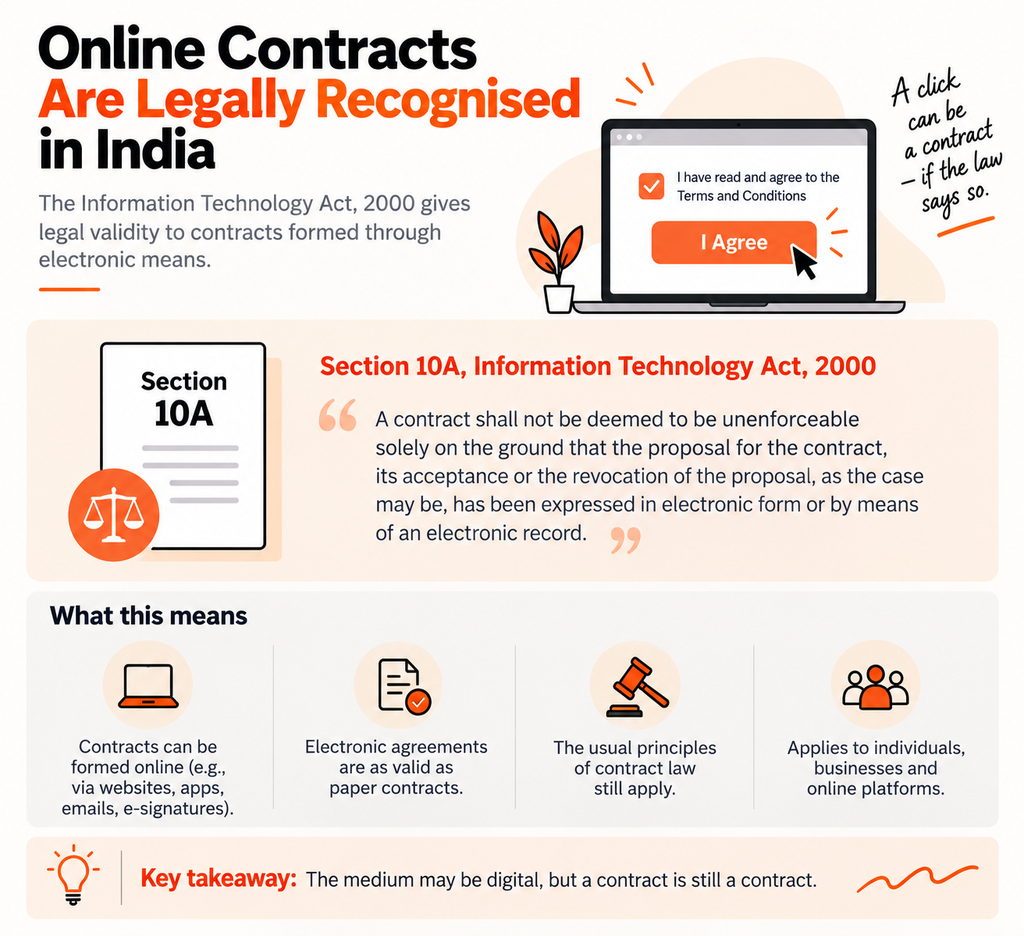
Image 1: Section 10A of IT Act, 2000
However, this does not mean that every “I Agree” button magically creates a valid contract.
The basic principles of contract law still apply. The Indian Contract Act, 1872 requires, among other things, a valid agreement, competent parties, free consent, lawful consideration and a lawful object. In other words, moving the contract from paper to a screen does not remove the basic rules of contract formation.
The electronic format simply changes how consent is communicated.
Consider a simple example. You order a pair of shoes from an online platform. Before completing the purchase, you are shown the platform’s Terms and Conditions and are required to tick a box stating, “I agree to the Terms and Conditions.”That click can amount to acceptance
But imagine a different situation. You visit a website, and somewhere at the very bottom of the page there is a tiny hyperlink saying “Terms of Use”. You never click it and are never specifically asked to accept those terms. Can the website later argue that merely browsing the site meant that you agreed to every term contained in that document?
That is where things become more complicated.
“I Agree” Is Not Always the Same as “I Knowingly Agreed”
Online agreements generally take different forms.
The distinction matters because courts may look at whether the user had reasonable notice of the terms and whether their conduct objectively demonstrated consent. Clickwrap agreements generally provide stronger evidence of assent because the user has been asked to take a specific action connected to the Terms. Browsewrap arrangements can raise more difficult questions where the terms were difficult to find or there was no clear indication that continued use amounted to acceptance.
This is why the design of a website or app can become surprisingly important in a contract dispute.
A prominent “I Agree” button immediately next to a clearly accessible set of Terms is very different from a tiny hyperlink buried in the footer of a webpage.
The question is not simply “Was there a Terms and Conditions page?”
The better question is: “Was there a sufficiently clear opportunity for the user to know what they were agreeing to?”
But What If I Never Read the Terms?
This is probably the most relatable question of all.
Most people do not read the Terms and Conditions of every app or website they use. Some agreements can run into dozens of pages, filled with legal language that the average user may find difficult to understand.
Does that mean the agreement is automatically invalid? Not necessarily.
Where a person has clearly accepted contractual terms, the fact that they did not actually read every word does not, by itself, destroy the agreement. The circumstances surrounding acceptance still matter. Indian courts have recognised electronic contracts, including contracts concluded through email, where the essential requirements of a contract are satisfied.
In Trimex International FZE Ltd. v. Vedanta Aluminium Ltd.2, the Supreme Court recognised that a binding contract could be concluded through an exchange of emails where the parties had agreed upon the essential terms and demonstrated an intention to be bound. The absence of a subsequently signed formal agreement did not, by itself, defeat the contract.
But there is an important qualification.
Consent is not a licence to impose anything imaginable on the other party.
Standard-form contracts, including online Terms and Conditions, may be scrutinised where their terms are unfair, unreasonable or unconscionable, particularly where there is a significant imbalance in bargaining power. Consumer protection law can also become relevant where an agreement contains an “unfair contract” in a consumer transaction.
For example, imagine a food delivery platform’s Terms state that the company can cancel your account at any time, for any reason, while retaining all amounts paid by you, without providing any remedy whatsoever.
The fact that you clicked “I Agree” does not necessarily end the legal analysis.
The enforceability of a particular clause can depend on its wording, the nature of the transaction, the parties involved and the applicable law.
Can Companies Put Anything They Want in Their Terms?
No.
This is where the popular idea that “I clicked it, so I agreed to everything” becomes misleading.
Contractual freedom is an important principle, but it operates within the boundaries of law.
An online platform may establish rules governing the use of its service. It may restrict certain conduct, establish payment obligations, specify dispute-resolution mechanisms and set out circumstances in which an account may be suspended. But contractual terms cannot simply override mandatory legal rights or make an unlawful provision valid.
This is particularly important in consumer transactions, employment relationships and situations involving unequal bargaining power.
The wording of the clause also matters.
A clause that clearly states, for example, “The subscription will automatically renew unless cancelled before the renewal date” is very different from a vague clause hidden inside several pages of Terms that gives the company an unrestricted power to make significant changes without notice.
For lawyers, this is where the real work begins.
The challenge is not merely writing a long contract. It is writing terms that are clear, precise, legally enforceable and appropriate for the transaction.
From “I Agree” to “I Drafted It”: Why Contract Drafting Matters
The next time you click “I Agree”, pause for a second.
That tiny button represents something lawyers have dealt with for centuries: consent, obligations, rights and risk. The only difference is that today, the contract may appear on a phone screen rather than across a conference-room table.
For law students, this makes understanding contract drafting particularly important.
Knowing the essentials of a valid contract is one thing. Knowing how to convert those principles into a properly drafted agreement is another.
Whether it is a website’s Terms and Conditions, an employment agreement, a non-disclosure agreement, a service agreement or a commercial contract, the drafting determines how clearly the parties’ rights and obligations are expressed.
A well-drafted contract should answer questions before they become disputes. What exactly has been promised? What happens if one party fails to perform? Can the agreement be terminated? Who bears the risk? How will disputes be resolved? Which law applies?
These are not merely theoretical questions. They are the questions lawyers are expected to anticipate when drafting contracts.
So the next time you see “I Agree”, remember that somewhere behind that button is a contract. And someone had to draft it.
If you want to build this practical skill and learn how contract drafting works in real-world legal practice, check out Lawctopus Law School’s 6-Month Course on ‘Mastering Contract Drafting and Freelancing’.
Call us at +91 93596 84056 for a free counselling call or write to us at courses@lawctopus.com for personalised career advice.
References
- Information Technology Act, 2000, Section 10A, https://indiankanoon.org/doc/1854142/ ↩︎
- Trimex International FZE Ltd. v. Vedanta Aluminium Ltd., (2010) 3 SCC 1. ↩︎
About the Author
Ms. Varshni Krishnan holds a B.A. LL.B. and LL.M. from Amity University, Noida. She is a recipient of the prestigious Goolam E. Vahanvati Award, 2018 and currently works as a Legal Content Manager at Lawctopus.