
Most commercial agreements contain three familiar protection clauses, representations, warranties, and indemnities. They often appear together under one “Representations, Warranties & Indemnities” heading, but they do very different jobs.
That difference matters when the deal goes wrong. A party may discover an undisclosed liability after signing a deal, or find that a warranted fact turns out to be false. The questions then become practical, which clause applies? What must be proved? And what can be recovered? Each concept answers these questions differently, and treating them as interchangeable can leave the parties without the protection they actually need.
Consider a hypothetical scenario of Kanchan Sarees Pvt. Ltd. (“Kanchan Sarees”) which is a three generation textile business in Surat. A Mumbai based private equity fund, Copperline Capital, (“Copperline”) agrees to acquire 100% of the company and add it to its textile portfolio ahead of a planned Initial Public Offering (“IPO”).
The share purchase agreement contains three key protections: Kanchan Sarees represents that it has no outstanding tax liabilities except those disclosed in the agreement, warrants that its books fairly reflect the company’s financial position as of the balance sheet date, and separately requires the promoter family to indemnify Copperline against any tax liability relating to the period before closing.
Fourteen months after acquisition, just as the IPO paperwork is being finalised, the GST department raises a demand for undervalued invoicing covering the previous three years, none of which was disclosed in the data room. Copperline now has three legally distinct routes to address the same problem, and which route its lawyers rely on could determine whether the dispute is resolved quickly or turns into a lengthy legal battle.
For context on the groundwork that often precedes a transaction, see Pre-Contractual Agreements: A Guide for Mastering the Step Before the Final Contract. The confidentiality of information shared during this process also matters; see 5 Key Clauses in an NDA: What Lawyers Should Review.
What a representation clause actually does
A representation is a statement of fact which is made in order to induce the other party to enter into a contract. It is because this was the reason which caused the buyer to sign, rather than a promise forming part of the contractual bargain.
If a representation proves false, the traditional remedy is rescission, which allows the affected party to have the contract cancelled and the parties restored, as far as possible, to their pre contractual position where consent was obtained through misrepresentation as per Section 19 of the Indian Contract Act, 1872, (the “Act”)1 with the mechanics of rescission governed by the Specific Relief Act, 1963 under Sections 27 to 30.2 Where the statement was made knowingly or without belief in its truth, it may amount to fraud as per Section 17 of the Indian Contract Act, potentially allowing damages in addition to rescission.3
The issue for a buyer who only relies upon representation is that the buyer would have to establish that the statement was material and that it actually led him to enter the deal. This can be difficult when negotiations are lengthy and the buyer has considered many other factors.
After closing the deal, the problem is even greater because although rescission may be available, it is often impractical to have the seller rescind the operating business or undo the completed share transfer.
What a warranty clause actually does
A warranty is the seller’s contractual promise that a particular fact about the company is true. While a representation provides information to induce the other party to enter the deal, a warranty forms part of the bargain itself.
The seller is not merely saying “this is true”; the seller is promising “this is contractually true.” For example, if a seller warrants that “the company has no outstanding statutory liabilities,” the statement becomes a contractual term. If it proves false, the buyer may have a claim for breach of warranty, without having to establish that the statement influenced its decision to enter the transaction.
As explained in All India General Insurance Co. Ltd. v. S.P. Maheswari, the Madras High Court drew this distinction,4 where a statement forms the basis of the contract, its materiality does not determine whether its incorrectness amounts to a breach. This distinction matters in M&A drafting because buyers can turn important due-diligence findings into contractual promises. A representation tells the buyer what is true; a warranty makes the seller contractually answerable if it is not.
For a practical discussion of negotiating commercial terms, see Negotiation of a Commercial Contract: How to Turn The Tide in Your Favour?.
The remedy of the buyer if he suffers a breach of warranty is generally damages under Section 73 of the Act.5 But that remedy has practical limits, the buyer must prove actual loss caused by the breach and quantify it, while the claim remains subject to ordinary rules on causation, foreseeability, and mitigation. A warranty, then, does not necessarily entitle the buyer to be made whole for all issues that may be discovered after the transaction closes. The buyer can only recover the loss that can be causally connected to the breach and be shown by application of the principles of damages.
What an indemnity clause actually does
An indemnity is different from both a representation and a warranty. It is a promise in a contract to protect the other party from a certain loss or liability. Under Section 124 of the Act, an indemnity covers losses arising from the conduct of the indemnifier or another person, while Section 125 of the Act sets out the indemnity holder’s rights when a covered claim arises.6 Unlike a warranty, an indemnity does not require the buyer to prove that a contractual statement was false. The Seller’s obligation only begins at the occurrence of the specified loss or liability covered by the indemnity.
This is why buyers often seek a separate indemnity for specific risks, such as pre closing tax liabilities. The Bombay High Court’s decision in Gajanan Moreshwar Parelkar v. Moreshwar Madan Mantri (“Gajanan Moreshwar”) highlights its practical value. The Court held that where the indemnified liability has become absolute, the indemnity holder can call upon the indemnifier to meet that liability without necessarily having to pay it first and then seek recovery.7 In a deal, this could mean that if a pre closing tax liability crystallises, the buyer does not have to pay the tax liability and then bring a separate damages action against the seller for reimbursement of the expense.
Why the distinction between representations, warranties and indemnities matters
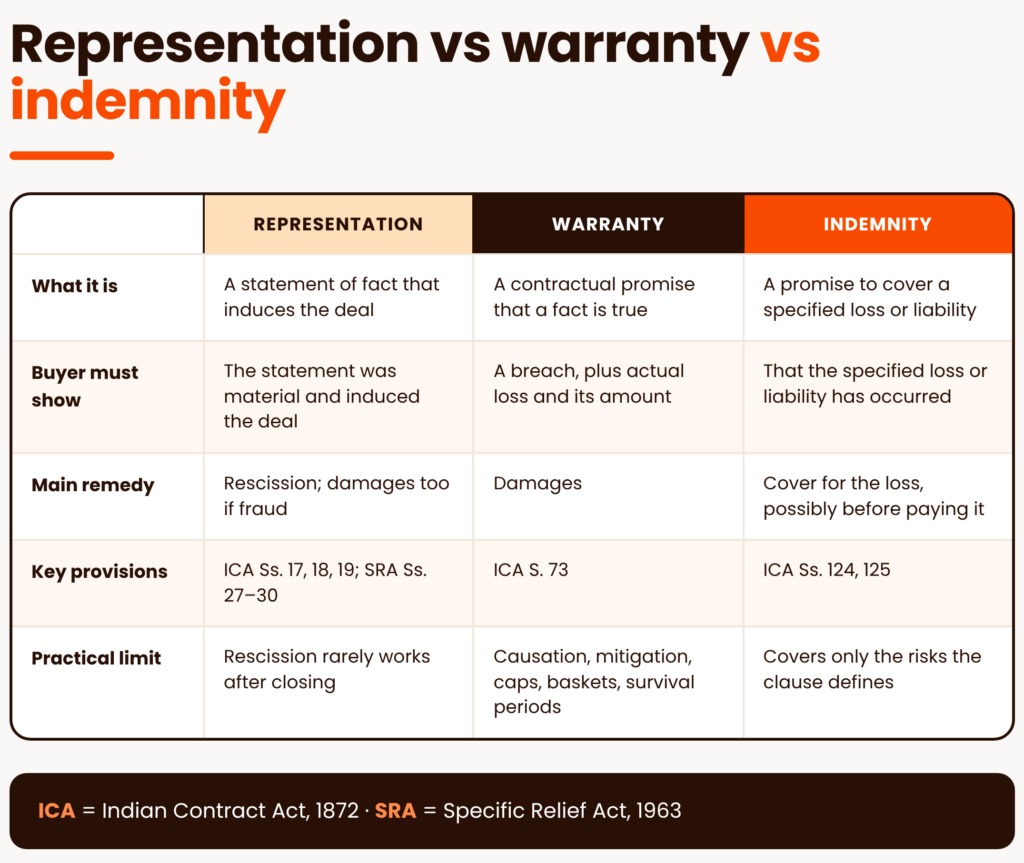
Image 1: Representation vs warranty vs indemnity
Now understanding it through the Kanchan Sarees scenario, by putting the three routes against the GST demand. Under the representation route, Copperline actually has a strong argument on the merits, the “no outstanding tax liabilities” statement was not something Copperline’s due diligence team simply missed. It was false because the company’s invoices had been undervalued for three years, suggesting that the promoter family had concealed the tax liability rather than Copperline failing to discover it.
This could support a claim of misrepresentation, or even fraud, under Sections 17 and 18. However, having a strong claim does not always mean that rescission is a practical remedy. Rescission requires the parties to be restored, as far as possible, to their pre-contract positions, and fourteen months after closing, Kanchan Sarees has already been integrated into Copperline’s business and is preparing for an IPO.
More importantly, Copperline does not want to return the business, they simply want the GST liability to be covered. Under the warranty route, Copperline has a clearer contractual claim because it does not need to prove that the false statement was material to the deal. However, it still has to prove the actual loss suffered and the amount it can recover under Section 73 of the Act. The recovery may also be limited by the agreement through caps (a maximum limit on the amount that can be recovered, often expressed as a percentage of the purchase price), baskets (a minimum amount of loss that must be reached before a claim can be made), and survival periods (the period during which a warranty claim can be brought, with general warranties often having shorter periods than tax-specific warranties).
Under the indemnity route, Copperline points to the defined trigger event which is a pre closing tax liability, and calls on the promoter family to cover it. As recognised in Gajanan Moreshwar, this may be possible even before Copperline has actually paid the GST department. For a related discussion of contractual risk allocation, see How to Draft the Perfect ‘Limitations of Liability’ Clause: Tips and Tricks.
Representations and warranties tell you who was wrong, an indemnity tells you who pays. And in practice, that second question is the one a buyer needs answered quickly. That is the practical value of getting the drafting accurately, the clause chosen after closing can determine what the buyer must prove, how much it can recover, and how quickly it can recover it. When a liability surfaces at the worst possible time, those differences can matter enormously. Clear and certain drafting is equally important; see Understanding Interpretation of Uncertain Terms of a Contract.
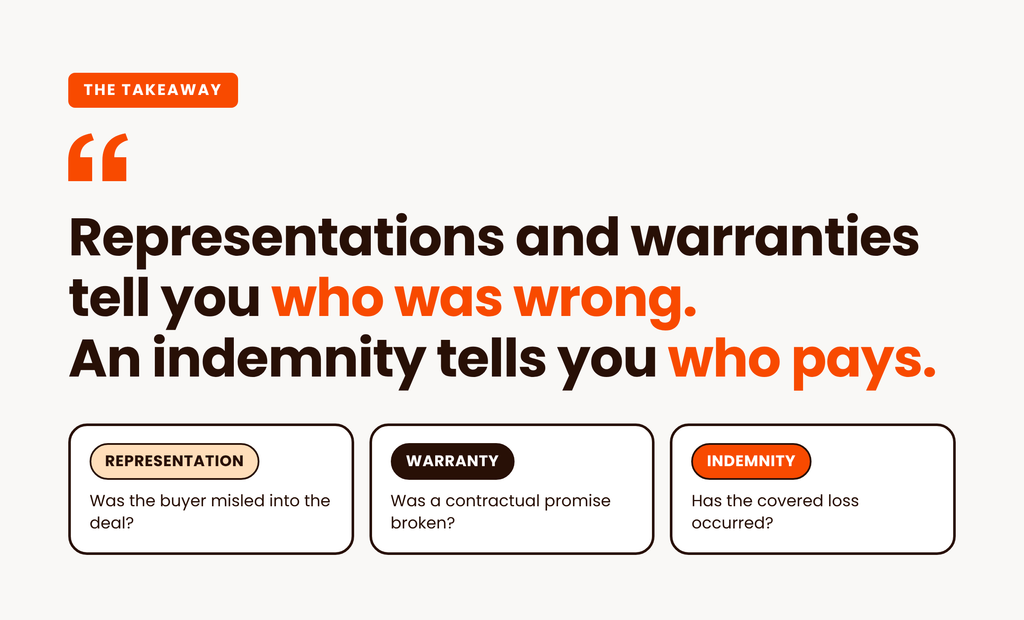
Image 2: Key takeaway
Further learning: For practical training in contract drafting and negotiation, explore LLS’s Contract Drafting & Negotiation course. For a deeper focus on transactions, due diligence and M&A documentation, see LLS’s Mergers and Acquisitions course.
Endnotes
- The Indian Contract Act, 1872, No. 9 of 1872, Section 19, India Code. ↩︎
- The Specific Relief Act, 1963, No. 47 of 1963, Section 27-30, India Code. ↩︎
- The Indian Contract Act, 1872, No. 9 of 1872, Section 19, India Code. ↩︎
- All India General Insurance Co. Ltd. v. S.P. Maheswari, AIR 1960 Mad 484 (Madras High Court, Nov. 5, 1959), https://indiankanoon.org/doc/693626/. ↩︎
- The Indian Contract Act, 1872, No. 9 of 1872, Section 73, India Code. ↩︎
- The Indian Contract Act, 1872, No. 9 of 1872, Section 124-125, India Code. ↩︎
- Gajanan Moreshwar Parelkar v. Moreshwar Madan Mantri, AIR 1942 Bom 302 (Bombay High Court, Apr. 1, 1942) (Chagla, J.), https://indiankanoon.org/doc/1361099/. ↩︎
About the Author
Jaideep Bedarkar is an LL.B. graduate and current LL.M. candidate (Business and Corporate Law) at Symbiosis Law School, Nagpur, with a keen interest in M&A, Private Equity, and Corporate Advisory. He holds a Certificate of Merit in Contract Drafting & Negotiation from Lawctopus Law School, and has interned in litigation practice across the Nagpur District Court and Bombay High Court.