
Let’s discuss a hypothetical scenario. Meera works in the finance department of a listed company. One evening, over a cup of chai, she tells her cousin Arjun that the company is about to announce a major acquisition. The announcement has not been made public, but Arjun sees an opportunity. He buys the company’s shares before the news breaks, hoping to profit when the price rises.
Has Arjun committed insider trading? Could Meera also face legal consequences for sharing the information?
The answers depend on the facts and the applicable legal provisions. Insider trading in India is regulated by the Securities and Exchange Board of India (SEBI). The rules cover more than trading by company directors or employees: they also address the communication of unpublished price sensitive information (UPSI) and trading while in possession of such information, subject to applicable exceptions.
To understand how insider trading in India is regulated, we need to examine SEBI’s Prohibition of Insider Trading Regulations, 2015, understand what qualifies as UPSI, and look at two important examples: the Hindustan Lever matter and the proceedings involving the Indian Energy Exchange (IEX).
What Is Insider Trading in India?
Insider trading usually refers to dealing in securities while in possession of unpublished price sensitive information (UPSI), in circumstances prohibited by law. It can also involve the improper communication or procurement of such information.
In India, the principal legal framework includes Section 12A(d) and Section 12A(e) of the Securities and Exchange Board of India Act, 1992, read with the SEBI (Prohibition of Insider Trading) Regulations, 2015.
The regulations address two related but distinct activities:
- Regulation 3 restricts communicating, providing or allowing access to UPSI, as well as procuring or causing the communication of UPSI, subject to specified exceptions.
- Regulation 4(1) generally prohibits an insider from trading in securities while in possession of UPSI, subject to the applicable provisions and exceptions.
This distinction matters. A person who shares information may raise a question under Regulation 3 even if that person does not trade. Similarly, a person who receives information and trades on it may raise a separate question under Regulation 4.
Neither conclusion should be reached without examining the relevant facts, definitions and exceptions.
Who Qualifies as an Insider Under India’s Insider Trading Rules?
It is easy to assume that insider trading rules apply only to company directors, senior executives or employees working with confidential financial information. The legal position is broader, but it is not unlimited.
Under Regulation 2(1)(g), an insider includes a connected person and a person in possession of or having access to UPSI. Whether someone falls within the definition depends on the applicable regulatory provisions and the facts of the situation.
A connected person is assessed under Regulation 2(1)(d). The definition covers specified relationships and circumstances that may give a person access to UPSI, subject to the terms of the regulations.
The rules also address relatives and certain people sharing a household or residence. The amendments notified in December 2024 revised aspects of the connected-person framework and introduced relevant presumptions. These provisions must be read carefully: they do not mean that every relative of a company employee is automatically guilty of insider trading.
For instance, Arjun’s relationship with Meera does not, by itself, settle his legal position. The relevant questions include whether the information qualifies as UPSI, how he obtained it, whether the applicable definition of insider covers him, and whether he traded in circumstances prohibited by the regulations.
Meera’s position also requires examination. Her role, access to information and conduct in communicating it may be relevant, but a definitive conclusion requires the facts to be assessed against the applicable provisions.
Watch the video: Insider Trading Explained
What Is UPSI Under Insider Trading Rules in India?
Not every piece of confidential company information qualifies as UPSI.
Regulation 2(1)(n) of the SEBI (Prohibition of Insider Trading) Regulations, 2015 defines UPSI by reference to information relating to a company or its securities that is not generally available and is likely to materially affect the price of securities when it becomes generally available.
The regulations identify categories of information that may qualify, including:
- Financial results.
- Dividends.
- Changes in capital structure.
- Mergers, demergers, acquisitions, delistings, disposals and expansion of business.
- Changes in key managerial personnel.
- Other matters specified under the applicable regulatory framework.
These are examples, not an automatic checklist. The information must satisfy the relevant legal requirements.
Consider Meera’s conversation with Arjun. If the acquisition information is not generally available and is likely to materially affect the company’s share price when disclosed, it may qualify as UPSI. A vague prediction about a possible business deal, on the other hand, does not automatically meet that test.
The distinction between confidential information and UPSI is important because the insider-trading regulations do not prohibit every private conversation about a company. They regulate particular conduct involving information that meets the legal definition.
For a related perspective on how acquisitions are structured, read our guide to Material Adverse Effect Clauses in M&A: Meaning, Drafting and Negotiation.
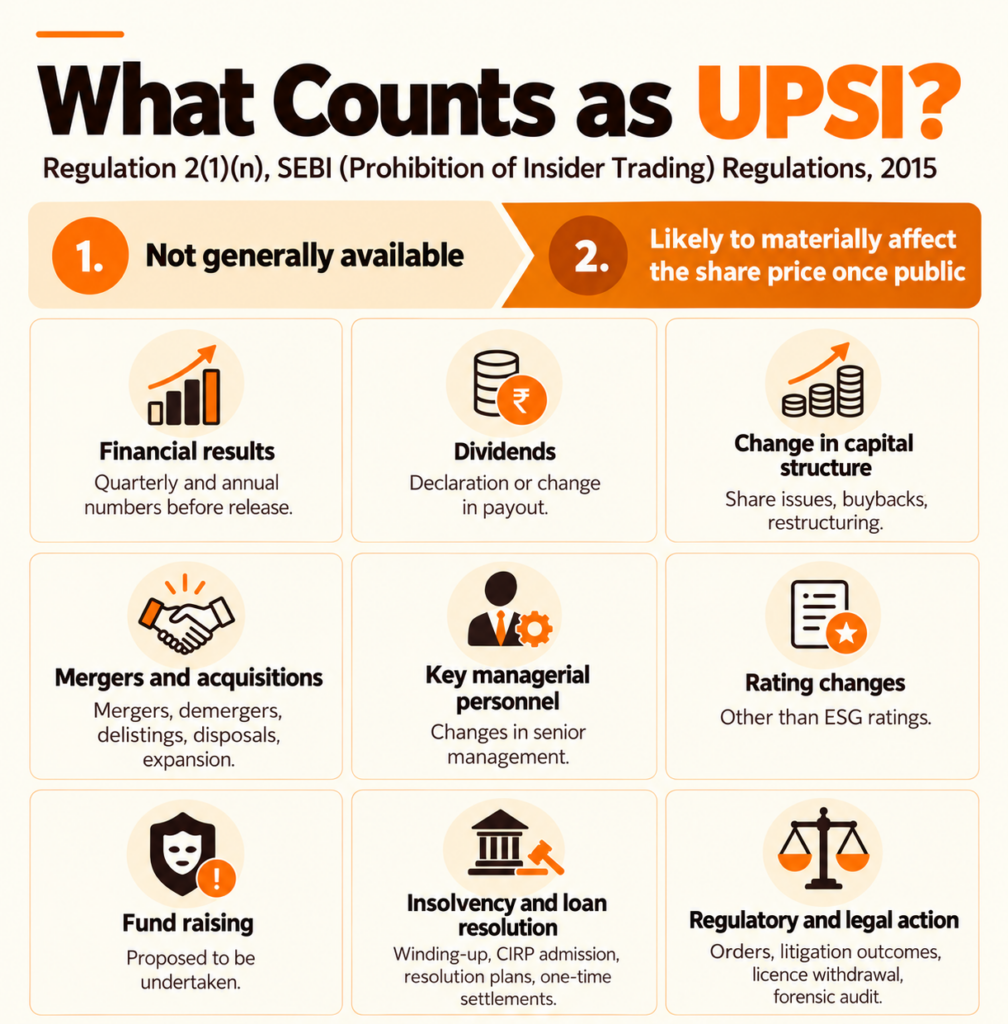
Image: What Counts as UPSI?
Do WhatsApp rumours make information public?
Suppose a message about a potential merger starts circulating in a WhatsApp group. Does that mean anyone can trade on the information? Not necessarily.
A rumour appearing on social media does not, by itself, establish that the underlying information has become generally available under the regulations. The source, content, reliability and circumstances surrounding the information may all be relevant.
The question is whether the information has become generally available in the sense contemplated by the regulations, not simply whether somebody has mentioned it online.
Insider Trading in India: The Hindustan Lever Case
The Hindustan Lever matter is an important historical example in discussions about insider trading and the difference between market speculation and information becoming generally available.
In 1996, Hindustan Lever Limited (HLL), now Hindustan Unilever Limited, purchased eight lakh shares of Brooke Bond Lipton India Limited before a proposed merger became public. The transaction attracted SEBI’s attention because of the timing of the purchase and the information surrounding the proposed merger.
SEBI took action against HLL in 1998. The matter raised questions about whether the merger-related information was unpublished and price-sensitive when the shares were purchased, and whether the transaction attracted the restrictions then applicable.
The case is relevant to a question that remains important today: does market speculation mean that price-sensitive information is public?
The answer cannot be reduced to whether a newspaper, broker or market participant has mentioned a possible transaction. A rumour or speculative report is not necessarily equivalent to information becoming generally available under the applicable legal framework.
The current insider-trading regulations contain their own definition of generally available information and must be applied on their terms. The historical matter should therefore be read in its legal and factual context, rather than treated as a rule that any media mention either makes information public or leaves it unpublished.
For anyone analysing an insider-trading dispute, the key is to identify the information at issue, establish what was available to the public at the relevant time, and examine the legal test applicable to the transaction.
To understand another aspect of shareholding and corporate transactions, read How to Draft a Shareholders’ Agreement.
Insider Trading in India: The IEX Case and Alleged Gains of Rs. 173 Crore
The proceedings involving the Indian Energy Exchange (IEX) show how information about regulatory developments can raise questions under insider-trading law.
IEX operates an electronic platform for electricity trading. One issue relevant to its business was the proposed introduction of market coupling: a process under which electricity prices across participating exchanges may be determined through a common mechanism. Changes to the market structure can affect how an exchange operates and how investors assess its business prospects.
In July 2025, developments concerning market coupling came into focus following directions from the Central Electricity Regulatory Commission (CERC). The subsequent regulatory developments became relevant to SEBI’s examination of trading in IEX shares.
On 15 October 2025, SEBI issued an interim order in the matter. Its prima facie assessment raised concerns about trading by certain individuals in the context of information relating to market coupling. The order referred to alleged gains of approximately Rs. 173.14 crore.
These figures and findings must be described carefully. An interim order records the regulator’s position at a preliminary stage; it should not be presented as a final adjudication of liability.
The proceedings also involved subsequent legal developments, including reported interim relief from the Punjab and Haryana High Court in April 2026. The precise scope of that relief, the parties covered by it and any subsequent orders must be checked against the original court record before publication. A stay is procedural relief, not a final finding that insider trading did or did not occur.
The IEX matter illustrates why timing and access to information can be significant in an insider-trading investigation. If information about a regulatory change is not generally available and is likely to materially affect a company’s securities, trading before public disclosure may attract scrutiny. Whether a particular person has violated the regulations, however, depends on the evidence and the applicable legal tests.
What Should Meera and Arjun Have Done?
Return to the conversation over chai.
Meera may have access to information through her employment. If that information qualifies as UPSI, she should not communicate it unless a permitted basis under the regulations applies. A personal conversation does not, by itself, create an exception.
Arjun should not assume that he can trade simply because he received the information from a relative rather than directly from the company. The source of the information, its status, his possession of it and the circumstances of his trading may all matter under the regulations.
A practical approach is to ask three questions before acting on information about a listed company:
- Is the information generally available? Check whether the information has been disclosed through an appropriate public channel, rather than relying on rumours or private messages.
- Could it qualify as UPSI? Assess whether it meets the regulatory definition, including the requirement that it is likely to materially affect the price of securities when generally available.
- Would communicating or trading on it be permitted? Consider Regulations 3 and 4 separately, along with the applicable exceptions and other relevant requirements.
These questions do not replace legal advice or a fact-specific assessment. They do, however, help identify when apparently casual information may raise a serious compliance concern.
Why Insider-Trading Rules Matter
Insider-trading restrictions are intended to protect the fairness and integrity of the securities market. Investors should not have to compete against people who can profit from material information that has not been made generally available.
The rules also recognise that access to information can arise through professional relationships and other connections, not only through formal positions in a company. That is why the definitions of insider, connected person and UPSI matter.
At the same time, allegations must be assessed through the applicable legal standards and evidence. A family relationship, a rumour or a suspiciously timed transaction should not automatically be treated as proof of a violation.
The conversation between Meera and Arjun may last only a few minutes. The legal questions it raises can be considerably more complicated. The safest course is not to disclose UPSI without a permitted basis, not to trade while prohibited from doing so, and not to assume that a private conversation or online rumour removes legal risk.
You may also find our article on Physical Share Certificates: The Law behind India’s Shift to Demat useful for understanding the legal framework governing securities in India.
Ready to pursue a career in corporate law? Explore the 6-Month Corporate Law Career Accelerator and enrol today to build practical legal skills and prepare for career opportunities in the field.
Disclaimer
This article is for general informational and educational purposes only. It is not legal advice. The application of insider-trading regulations depends on the facts, the applicable law and the status of relevant proceedings. Readers should consult the current regulations and primary legal documents before relying on any legal proposition.
Endnotes
- Securities and Exchange Board of India Act, 1992, No. 15 of 1992, Section 12A(d)-(e) (India).
- SEBI (Prohibition of Insider Trading) Regulations, 2015 (India), https://www.sebi.gov.in/legal/regulations/jan-2015/sebi-prohibition-of-insider-trading-regulations-2015-issued-on-15-jan-2015-28884.html.
- Id. regs. 3(2), 4(1).
- Id. reg. 2(1)(d).
- Notification Dec. 4, 2024, amending SEBI (Prohibition of Insider Trading) Regulations, 2015; SEBI Amends Insider Trading Regulations, AZB & Partners (Jan. 23, 2025), https://www.azbpartners.com/bank/sebi-amends-insider-trading-regulations/.
- SEBI (Prohibition of Insider Trading) Regulations, 2015, reg. 2(1)(n) (India).
- Id. reg. 2(1)(e).
- Press Release, SEBI, Action Against Hindustan Lever Limited, PR 50/98 (Mar. 11, 1998), https://www.sebi.gov.in/media/press-releases/mar-1998/action-against-hindustan-lever-limited_18764.html.
- Insider Trading: Hindustan Lever Limited v. SEBI, India Corp. L. (Oct. 25, 2017), https://corporate.cyrilamarchandblogs.com/2017/10/insider-trading-hindustan-lever-limited-v-sebi/.
- Punjab & Haryana High Court Suspends SEBI’s IEX Insider Trading Investigation, ETLegalWorld (Apr. 14, 2026), https://legal.economictimes.indiatimes.com/news/litigation/punjab-haryana-high-court-suspends-sebis-iex-insider-trading-investigation/130249419.
- Sebi Faces Setback After Punjab and Haryana High Court Stays Rs 173-Crore Insider-Trading Order in IEX Case, Moneycontrol (Apr. 13, 2026), https://www.moneycontrol.com/news/business/sebi-faces-setback-as-its-rs-173-crore-insider-trading-order-against-iex-stayed-by-punjab-and-haryana-high-court-13887397.html.
- SEBI, Ex-Parte Interim Order, Matter of Insider Trading by Certain Entities in the Scrip of Indian Energy Exchange Ltd., WTM/KV/ISD/ISD-SEC-2/31727/2025-26 (Oct. 15, 2025), https://www.sebi.gov.in/sebi_data/attachdocs/oct-2025/interim_order_ie1.pdf.
- Id.
- ETLegalWorld, supra note 10.
About the Author
Ms. Soumya Chaturvedi is a Learning Manager at Lawctopus Law School and an ex-Associate at IndusLaw, where she worked in the Capital Markets team. A 2021 graduate of NLU Odisha, she has previously interned with leading law firms including LKS, DSK Legal, and L&L Partners.