
Introduction
Imagine that your client, a trillion dollar television manufacturer, has signed an agreement to deliver 5000 units of television by the end of the quarter. You client has planned the delivery schedule and made all the necessary arrangements. However, in the last week of the quarter a major flood ruins your client’s warehouse and the highways are closed. Despite having completed all the necessary steps on their end, your client was not able to deliver the items on time.
What happens next? Can the buyer claim compensation for the delay? Can your client be excused from performing its obligations?
This is where a force majeure clause in a contract becomes important.
A force majeure clause sets out the circumstances in which an event beyond a party’s reasonable control may excuse, suspend or delay the performance of certain contractual obligations, depending on the wording of the contract.
For lawyers, the challenge is not simply to include this clause in an agreement. It is to define the covered events, establish the conditions for invoking the clause, and decide what happens if the disruption continues.
What Is a Force Majeure Clause?
The French term force majeure means “superior force”. In contract law, it generally refers to an exceptional event beyond a party’s reasonable control that affects its ability to perform contractual obligations.
A force majeure clause identifies the events that may trigger relief and explains what happens when one of those events affects a contract.
What is the purpose of a force majeure clause? Its purpose is to allocate the risk of specified unexpected events between the parties. Depending on the contract, it may allow an extension of time, suspension of affected obligations or termination after a specified period.
For example, a supply agreement may provide relief if a flood prevents a manufacturer from delivering goods. However, whether the manufacturer can invoke the clause will depend on the contract’s wording, the circumstances of the event and the requirements for claiming relief.
An unexpected event does not automatically qualify as force majeure. The event must fall within the applicable contractual provision or satisfy the relevant legal requirements.
When drafting a contract, it is also important to understand how its different provisions work together. Read this guide to the preliminary terms in contract drafting to learn more.
What Are Common Examples of Force Majeure Events?
Depending on how the clause is drafted, force majeure events may include:
- Natural disasters, such as floods, earthquakes and cyclones.
- War, riots and certain civil disturbances.
- Epidemics or pandemics, where covered by the clause.
- Government orders or restrictions that prevent contractual performance.
- Fires and other serious accidents.
- Strikes or labour disruptions, where expressly included or otherwise covered by the clause.
The list is not universal. A contract may expressly include certain events and exclude others. Lawyers should therefore examine the wording rather than assume that every unexpected event qualifies.
How Does a Force Majeure Clause Work?
A force majeure clause generally establishes the circumstances in which a party may seek relief from its contractual obligations.
Consider a manufacturer that is required to deliver goods within 30 days. A flood closes the only route to its warehouse, preventing delivery.
If the contract covers floods and transportation disruptions, and the manufacturer satisfies the clause’s other requirements, it may be entitled to the relief specified in the agreement.
That relief might include an extension of time, suspension of affected obligations or termination after a specified period. The actual consequences depend on the contract.
Four important points should be examined when reviewing a force majeure clause.
4 Essential Elements of a Force Majeure Clause
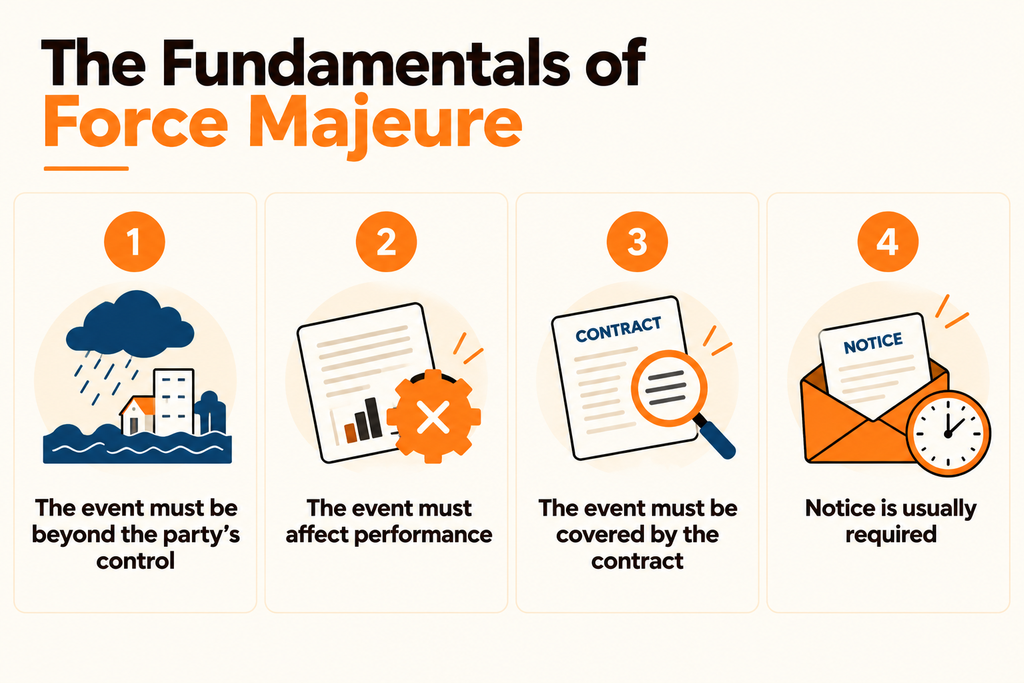
Image: The Fundamentals of Force Majeure
1. The Event Must Be Beyond the Party’s Reasonable Control
First, we need to understand whether the incident was truly beyond the control of the injured party. The clause should identify the types of events that may qualify for relief. These might include natural disasters, government restrictions or specified civil disturbances.
When drafting the clause, consider the nature of the transaction and the risks the parties are likely to face.
For example, a manufacturing agreement may need to address disruptions affecting factories, transport routes or critical supplies. A clause that lists only floods and earthquakes may not adequately address every risk relevant to that agreement.
2. The Event Must Affect Contractual Performance
An event occurring at the same time as a contractual delay does not establish that the event caused the delay.
The affected party should be able to explain how the event prevented, delayed or materially affected its performance, as required by the clause.
For instance, if flooding closes a warehouse and prevents access to the goods, the manufacturer should document the closure and explain its effect on the delivery schedule.
The contractual wording matters: some clauses require prevention of performance, while others also cover delay or material disruption.
3. The incident must fit the definition specified in the contract
Your job as a lawyer is important here. A force majeure clause should clearly define the events that trigger relief. Consider a contract that expressly includes floods, earthquakes and government restrictions but does not mention labour shortages or supply chain interruptions. Whether a particular disruption is covered will depend on the precise wording and its interpretation.
When drafting, decide whether to use an illustrative list of events or a more exhaustive list. Also consider whether certain events should be expressly excluded.
4. Notice Requirements Must Be Followed
Many force majeure clauses require the affected party to notify the other party within a specified period. The clause should clarify:
- When notice must be given.
- Who must receive the notice.
- How the notice must be delivered.
- What information or supporting documents must be provided.
- Whether updates are required while the disruption continues.
For example, a contract may require written notice within five business days of the event, together with details of the affected obligations and the expected duration of the disruption.
The notice period and procedure should suit the transaction. The parties should also consider the consequences of failing to comply with the notice requirements.
Force Majeure Under Indian Contract Law
In India, the legal treatment of force majeure depends on the contract and the circumstances of the case. In Energy Watchdog v. Central Electricity Regulatory Commission, (2017) 14 SCC 80, the Supreme Court of India discussed the distinction between contractual force majeure provisions and the doctrine of frustration under the Indian Contract Act, 1872.
Broadly, Section 32 deals with contingent contracts and is relevant when contractual relief depends on an event specified in the agreement. Section 56 addresses agreements that become impossible or unlawful in the circumstances covered by that provision.
What is the difference between force majeure and frustration of contract in India? A contractual force majeure provision is generally examined in light of the agreement and Section 32, while Section 56 addresses frustration in circumstances covered by that provision. The precise application depends on the contract and the facts.
Is a force majeure clause mandatory in every contract? There is no universal requirement that every contract contain such a clause. Whether one is appropriate depends on the transaction, the risks involved and the parties’ commercial objectives.
A party should not assume that increased costs, commercial inconvenience or an unexpected event automatically excuse performance. The applicable contractual terms, the event’s effect on performance and the relevant legal principles must be examined.
How to Negotiate Force Majeure Clause
Drafting a force majeure clause requires lawyers to consider the interests of both parties and decide how the risks of unexpected events will be allocated.
- Discuss the concept
Start by identifying the events most relevant to the transaction.
If you represent a supplier, you may want the clause to cover a wider range of events that could disrupt production or delivery. If you represent the buyer, you may want a narrower definition and clear limits on when the supplier can claim relief.
Consider whether the clause should address government restrictions, transportation disruptions, supply shortages and interruptions affecting critical infrastructure.
- Discuss the cutoff
The clause should explain the required impact on performance. Does the event need to make performance impossible? Is material delay sufficient? Can the clause be invoked when only part of an obligation is affected?
For example, a supplier may still be able to deliver goods through an alternative route, although at a higher cost. Whether this situation qualifies for relief depends on the contract’s wording and the applicable legal principles.
- Set Reasonable Notice and Mitigation Requirements
Consider how quickly the affected party must notify the other party and what steps it must take to reduce the impact of the event.
A clause may require the affected party to take reasonable steps to mitigate the disruption, explore alternative arrangements and keep the other party informed.
What should a lawyer check before invoking a force majeure clause? The lawyer should review the definition of force majeure, the event’s impact on performance, notice requirements, mitigation obligations, supporting evidence and the relief available under the contract.
- Decide When Either Party Can Terminate the Contract
What happens if the force majeure event continues for several months?
The clause may provide a long-stop period after which either party can terminate the agreement. The parties should negotiate how long the disruption must continue before termination becomes available, who can exercise the right, whether termination affects the entire agreement and how outstanding payments and undelivered goods will be handled.
For more practical guidance, read LLS Magazine’s article on negotiating a commercial contract.
Force Majeure Clause Drafting Checklist
Before finalising a force majeure clause, consider the following questions:
- Are the covered events clearly defined?
- Is the list illustrative or exhaustive?
- Are any events expressly excluded?
- Does the clause specify the required impact on performance?
- Are notice deadlines and delivery methods clear?
- Does the clause require evidence of the event and its impact?
- Are mitigation obligations reasonable and specific?
- Does the agreement explain whether obligations are suspended, extended or otherwise affected?
- Is there a long-stop period for termination?
- Does the clause explain the consequences of termination?
Use this checklist when reviewing a draft agreement or preparing for contract negotiations. The answers should be adapted to the transaction rather than copied mechanically from another contract.
To explore other important contractual provisions, browse the LLS Magazine Contract Drafting section, which includes articles on limitation of liability, waiver, termination and other contract clauses.
Conclusion
A force majeure clause helps parties understand how specified unexpected events may affect their contractual obligations. For lawyers, the key tasks are to define the covered events, establish clear notice and mitigation requirements, determine the relief available and decide what happens if the disruption continues.
The clause should reflect the risks of the particular transaction and the interests of both parties. Careful drafting and negotiation can help reduce uncertainty when circumstances prevent a contract from proceeding as planned.
Want to improve your contract drafting and negotiation skills?
Explore Lawctopus Law School’s Contract Drafting and Negotiation course to learn about drafting, reviewing and negotiating contracts through practical exercises and feedback.
For course details, reach out to Aaditya Kashyap, Counsellor, Lawctopus Law School, at +91 93596 84056 or [email protected].
About the Author
Simran Sabharwal is a Gold Medallist in Business Laws from RGNUL, Punjab, and a former Associate at Khaitan & Co. She is currently a Learning and Editorial Manager (Corporate Vertical) at Lawctopus Law School, where she teaches corporate law and practical commercial drafting.