Property Law is a subject you should not overlook while preparing for CLAT PG 2027. Learners often think of skipping Property Law while preparing for CLAT PG. It is usually pushed down the priority list because Constitutional Law, Criminal Law, Jurisprudence and other subjects appear more frequently in discussions. But that strategy can cost you easy marks.
Property Law has been tested through conceptual and application-based questions, particularly from the Transfer of Property Act. The official CLAT PG syllabus specifically includes Property Law, and the 2027 paper continues to test candidates through passages drawn from statutes and judgments, followed by questions requiring application of legal principles.
So, how much weightage should you expect? There is no officially fixed subject-wise quota for Property Law in CLAT PG. Different analyses of previous papers suggest that it can contribute a meaningful set of questions, with some preparation sources estimating around 6 to 8 questions.
So, if you are short on time, which topics should you prepare first?
CLAT PG 2027: Important Property Law Topics to Prepare
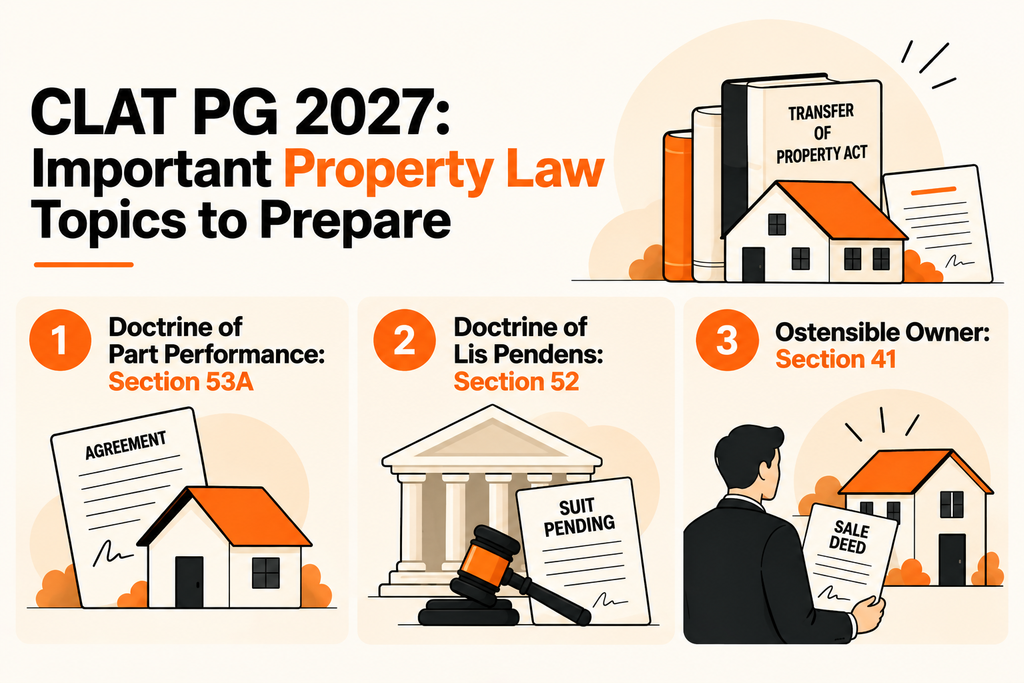
Image: Property Law Study Guide for CLAT PG Exam
1. Doctrine of Part Performance: Section 53A
This is one of those topics where knowing the section is not enough. You should know the conditions that must be satisfied for Section 53A to apply, including a written contract, possession or continuation in possession, an act in furtherance of the contract and willingness to perform the transferee’s obligations. Also remember the significance of registration after the 2001 amendment.
A typical CLAT PG question can give you a factual situation involving an unregistered agreement and possession and ask whether the transferee can claim protection. The focus is on application, not memorisation.
2. Doctrine of Lis Pendens: Section 52
This is another topic you should not leave for the last day. The basic idea is simple: a property involved in pending litigation should not be transferred in a manner that defeats the rights being decided by the court.
But here is the trap: a transfer during the pendency of litigation is not automatically void. The transferee is generally bound by the outcome of the litigation. CLAT PG can easily turn this into a passage by changing the timing of the transfer, the nature of the suit or the relationship between the parties. So prepare the ingredients of Section 52 and understand how the doctrine operates in practical situations.
3. Ostensible Owner: Section 41
Section 41 is perfect for a CLAT PG-style application question. The key question is: Can someone who appears to be the owner validly transfer the property when they are not actually the owner?
To answer it, remember the conditions. There must be the consent, express or implied, of the real owner; the transfer must be for consideration; the transferee must take reasonable care to ascertain the transferor’s authority; and the transferee must act in good faith.
Property Law does not require you to read the entire Transfer of Property Act with equal intensity. Start with high-yield doctrines and learn them through fact situations. Along with these three, keep sale, mortgage, lease, gift, election, actionable claims and registration on your revision list.
Judgments You Should Prepare for Property Law
Along with the bare provisions, make sure you prepare a few important judgments. CLAT PG often gives you a factual situation and expects you to identify the principle that applies, so knowing the ratio of the case is much more useful than simply remembering the case name.
1. Nathulal v. Phoolchand, (1969) 3 SCC 120
A must for Section 53A and part performance. The Supreme Court explained the essential conditions that a transferee must satisfy to claim protection under the doctrine, including a written contract, possession, an act in furtherance of the contract and willingness to perform.
2. Suraj Lamp & Industries (P) Ltd. v. State of Haryana, (2012) 1 SCC 656
Very important for understanding the difference between an agreement to sell and a completed sale. The Court reiterated that an agreement to sell does not, by itself, create title or transfer ownership. It also discussed the limited protection available under Section 53A.
3. Jayaram Mudaliar v. Ayyaswami, (1973) 1 SCC 569
Prepare this for Section 52 and the doctrine of lis pendens. The judgment explains why a property involved in litigation cannot be dealt with in a way that defeats the rights being determined by the court. Remember the core idea: a pendente lite transferee is bound by the result of the litigation.
4. Hardev Singh v. Gurmail Singh, (2007) 2 SCC 404
Useful for Section 41, transfer by an ostensible owner. The Supreme Court identified the key requirements: the transferor must be the ostensible owner with the consent of the real owner, the transfer must be for consideration, and the transferee must act in good faith after taking reasonable care.
So, if you were planning to skip Property Law, reconsider. Three well-prepared Property Law concepts can be much more valuable than attempting to cover the entire subject superficially. Read the Bare Act, understand the ingredients, revise important cases, and most importantly, practise applying the rule to changed facts. That is where CLAT PG is increasingly testing you.
Preparing for CLAT PG 2027? Start with the Right Topics.
Property Law is not just about remembering sections of the Transfer of Property Act. You need to understand how legal doctrines work, connect them with judgments, and apply them to passage-based questions.
Start with high-yield topics such as Part Performance, Lis Pendens and Ostensible Owner. Then build on that understanding with regular revision and practice across other subjects.
Need a structured approach to your CLAT PG preparation?
The Lawctopus CLAT PG Coaching Course brings together subject-wise reading modules, important judgments, quick revision guides, mock tests and recorded classes to help you prepare more systematically. Explore the course and make your CLAT PG 2027 preparation more focused.
About the Author
Ms. Mansi Mankotia holds a B.A. LL.B. and LL.M. from HPNLU, Shimla. She secured AIR 906 in CLAT PG 2020 and is currently a Senior Learning Manager at Lawctopus Law School.