
Daughter’s property rights in India have majorly evolved, particularly following the Hindu Succession (Amendment) Act, 2005. A daughter can be financially independent, well-educated and actively involved in caring for her parents, still she find herself fighting for her share of the family property.
But today also many women continue to face challenges when claiming their share of family property. Despite legal recognition of daughters’ inheritance rights, family pressure, misunderstandings about ancestral property and disputes over ownership can make it difficult for women to assert their claims.
“You are married now. Your brother will take care of the property.”
Many women hear statements like these when family property is divided. Some are told that ancestral property belongs only to sons. Others are asked to relinquish their share to preserve family relationships. But what does Indian law actually say about a daughter’s right to inherit property?
Understanding Daughter’s Ancestral Property Rights in India
The Hindu Succession Act, 1956, as amended in 2005, recognises daughters as coparceners in a Mitakshara Hindu joint family, subject to the applicable legal provisions.
Section 6 of the Act provides daughters with coparcenary status by birth, giving them rights and liabilities in coparcenary property comparable to those of sons.
Does marriage affect a daughter’s right to ancestral property? No. A daughter does not lose her coparcenary rights merely because she gets married. Marriage alone does not transfer her share to her brother or other male relatives.
However, not every property owned by a family is ancestral or coparcenary property. A property may have been purchased by a parent from their own earnings, inherited from another relative or held as coparcenary property. The applicable rules can differ in each situation.
A daughter does not automatically acquire a present ownership interest in every property owned by her father simply because she is his daughter. The nature of the property and the relevant succession rules must be examined.
How Did the Supreme Court Strengthen Daughters’ Inheritance Rights?
A landmark judgment on daughters’ property rights in India is Vineeta Sharma v. Rakesh Sharma (2020).
The Supreme Court clarified that a daughter’s coparcenary right under Section 6 of the Hindu Succession Act is by birth. Her entitlement does not depend on whether her father was alive on 9 September 2005, when the amendment came into force.
The Court also clarified that the father did not need to be alive when the amendment commenced for a daughter to claim the benefit of the provision.
Can a daughter claim a share in ancestral property if her father died before 2005? Her claim is not automatically defeated simply because her father died before the amendment came into force. The applicability of Section 6 and the principles laid down in Vineeta Sharma must be assessed alongside the facts of the case.
For example, suppose a father died before 2005, leaving behind a son and a daughter. The son argues that his sister cannot claim a share because their father was no longer alive when the amendment commenced. That argument alone does not settle the dispute. The nature of the property, the applicable law, previous partitions and transactions protected by law must also be examined.
The judgment was an important development in Hindu succession law, but it does not mean that every daughter automatically receives an equal share in every property dispute.
For law students interested in the practical side of family-law disputes, read Family Law Isn’t Just About Divorce: 7 Things Young Lawyers Need to Know. It explores the practical skills young lawyers need when working on family-law matters.
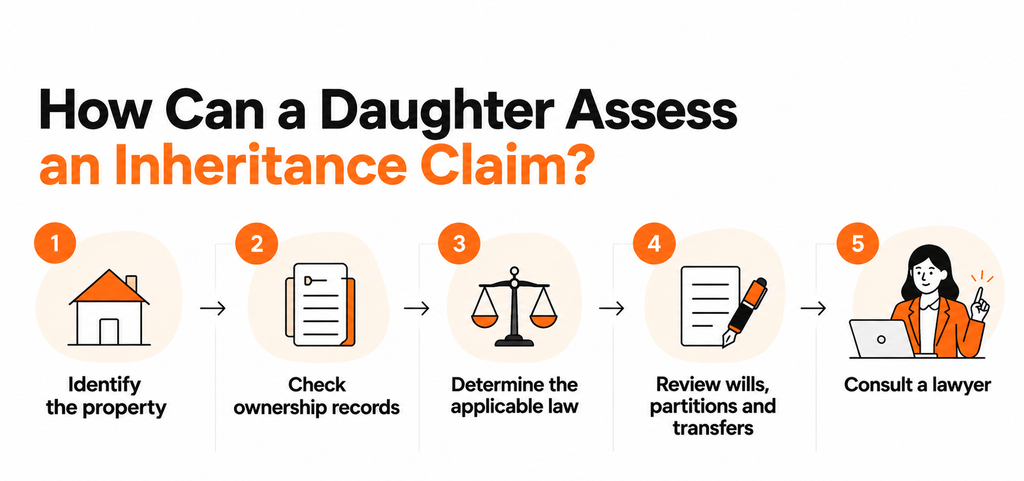
Image: Inheritance Claim Assessment Steps
Why Do Daughters Still Face Challenges in Inheritance Disputes?
If daughters have legal rights to coparcenary property, why do inheritance disputes continue? The reasons are often social, financial and practical, as well as legal.
A daughter may be told that wedding expenses, jewellery or gifts received at marriage constitute her share of the family property. Another may be asked to sign a relinquishment deed because her brother is considered more deserving of the property.
Some women sign documents without fully understanding their legal consequences. Others face pressure to give up their claims to avoid conflict with parents or siblings.
Wedding expenses and gifts do not automatically substitute for a legally recognised share of property. Whether a relinquishment or transfer document is valid depends on the document, the applicable law, registration requirements where relevant, and the circumstances in which it was executed. Allegations of fraud, coercion or undue influence may also require examination.
Pursuing an inheritance claim can involve legal expenses, strained family relationships and prolonged litigation. These practical difficulties may discourage women from asserting their rights.
However, choosing not to pursue a property claim is not the same as having no legal right to begin with. Understanding the law helps women make informed decisions instead of relying solely on what family members tell them.
Does Every Daughter Have the Same Inheritance Rights in India?
No. Inheritance rights depend on the personal law applicable to the family, the nature of the property and the relevant facts.
The Hindu Succession Act applies to the persons covered by Section 2, subject to its provisions and exceptions. Other communities may be governed by different personal laws with different rules for determining the shares of heirs.
For example, Muslim personal law generally governs inheritance among Muslims, and its rules differ from those under the Hindu Succession Act. The 2005 amendment to the Hindu Succession Act should not be assumed to apply uniformly to all Indian women.
Even within Hindu succession law, different categories of property must be distinguished.
What is the difference between ancestral property and self-acquired property?
Coparcenary property is subject to the applicable rules governing coparcenary rights, including Section 6 of the Hindu Succession Act. A daughter governed by that provision has coparcenary rights by birth, subject to the applicable statutory conditions and judicial interpretations.
Self-acquired property purchased by a parent from their own earnings is treated differently. A daughter does not automatically have a present ownership share in every such property during the parent’s lifetime merely because she is the parent’s child.
If a Hindu male dies without a will, succession is governed by Section 8 and the relevant succeeding provisions of the Act.
The property of a Hindu woman is also governed by specific provisions. Section 14 addresses property held by a female Hindu as her absolute property, subject to the terms and exceptions of that provision. Sections 15 and 16 deal with succession to the property of a female Hindu who dies intestate.
Where a valid will exists, its terms, the owner’s legal capacity to dispose of the property and the applicable law become relevant.
These distinctions matter because the expression “ancestral property” is often used loosely in everyday conversation. Property inherited from a parent is not automatically coparcenary property in every legal situation.
Before advising a client or initiating litigation, a lawyer should establish the property’s ownership history, identify the applicable personal law, examine the documents and determine whether any partition or transfer has taken place.
What Can a Daughter Do If Her Share in Family Property Is Denied?
A daughter who believes her inheritance rights have been ignored should begin by examining the property and its legal history rather than relying solely on verbal assurances from family members.
What documents should a daughter check before making an inheritance claim?
Depending on the circumstances, relevant documents may include:
- Title deeds and previous ownership records.
- Partition deeds.
- Gift deeds and relinquishment deeds.
- Wills and other succession-related documents.
- Revenue records and mutation entries.
- Documents relating to previous transfers or transactions.
The next step is to determine the applicable succession rules. A claim involving coparcenary property may require a different legal analysis from a claim involving the self-acquired property of a parent who died without a will.
Depending on the facts, a lawyer may advise the daughter to seek a declaration of her rights, partition and separate possession, or another appropriate remedy. If the property is at risk of being transferred or dealt with in a way that could prejudice her claim, interim relief may also need to be considered.
Does having a name in the revenue records conclusively establish ownership? Not necessarily. Mutation entries and revenue records may be relevant evidence, but their legal effect must be assessed in the context of the dispute and the applicable law.
Time is another important consideration. Limitation issues, the date and nature of an alleged partition, previous transactions and the relief sought may affect the legal strategy.
Most importantly, a daughter should not sign a relinquishment deed or transfer document without understanding its legal consequences. Where family pressure is involved, independent legal advice can help her understand her options.
For law students and young lawyers, organising documents is only the first step; understanding what a case file establishes is equally important. Read these 10 Simple Rules To Start Reading Case Files Efficiently, for practical guidance on examining legal case files.
The purpose of asserting inheritance rights is not to create conflict within a family. It is to ensure that decisions about property are informed, voluntary and consistent with the applicable law.
What Should Law Students and Young Lawyers Learn from Inheritance Disputes?
Inheritance disputes demonstrate why legal practice requires more than knowledge of statutory provisions.
A lawyer handling a property dispute must identify the applicable personal law, trace the history of ownership, analyse relevant documents and judgments, and determine the appropriate legal remedy.
The distinction between coparcenary property and self-acquired property can be crucial. So can the effect of a previous partition, a relinquishment deed or a will.
These cases also highlight the importance of clear legal research and precise drafting. A lawyer must be able to identify the relevant legal principles, apply them to the client’s facts and present a reasoned legal position.
Students and young lawyers who want to strengthen these skills can explore Lawctopus Law School’s Legal Research and Writing course. The course focuses on legal research, analysis, writing and referencing, skills that are useful across legal practice.
Readers interested in exploring related topics can also browse the Family Law section of LLS Magazine for more articles on family-law practice.
Equal Inheritance Requires More Than a Change in Law
The recognition of daughters as coparceners was a significant milestone in Hindu succession law. But meaningful equality also requires awareness, access to legal advice and the ability to understand property documents before signing them.
For daughters, knowing the applicable law can help them make informed decisions about family property. For lawyers, inheritance disputes are a reminder that effective legal assistance begins with careful research, a clear understanding of the facts and an appropriate remedy.
A legal right can make a difference only when the person entitled to it understands how that right applies to their circumstances and how it may be protected.
About the Author
Vishakha Girhe is a Learning Manager at Lawctopus Law School. She holds an LL.M. in Business Laws and has practised as an independent litigator at the Nagpur District Court and Bombay High Court, Nagpur Bench.