
A client enters into your office with a share certificate older than most of your junior associates. It’s legitimate, it’s got the company seal, the signatures, the whole thing. She wants to sell the shares. You’ve got to inform her that that piece of paper alone isn’t enough anymore- and hasn’t been for years.
This exact scene is played out quite often and, as a rule, invites the same question: when, exactly, did physical shares stop working, and why does the answer seem so different depending on who is the client you’re advising? In reality, India’s transition away from paper certificates was not a single law or a single date- it was a steady, intentional policy move over three decades and is ongoing till date. Let’s explore that in this piece!
How Shares Existed Before 1996?
For the majority of India’s corporate past, a share certificate represented ownership itself rather than merely serving as proof of ownership. Every transfer required physically submitting the certificate to the respective company, executing a transfer deed, waiting for board approval, and receiving a new certificate in the buyer’s name. This process was slow and carried real risks: forged signatures, lost certificates, and settlement cycles that could stretch for months.
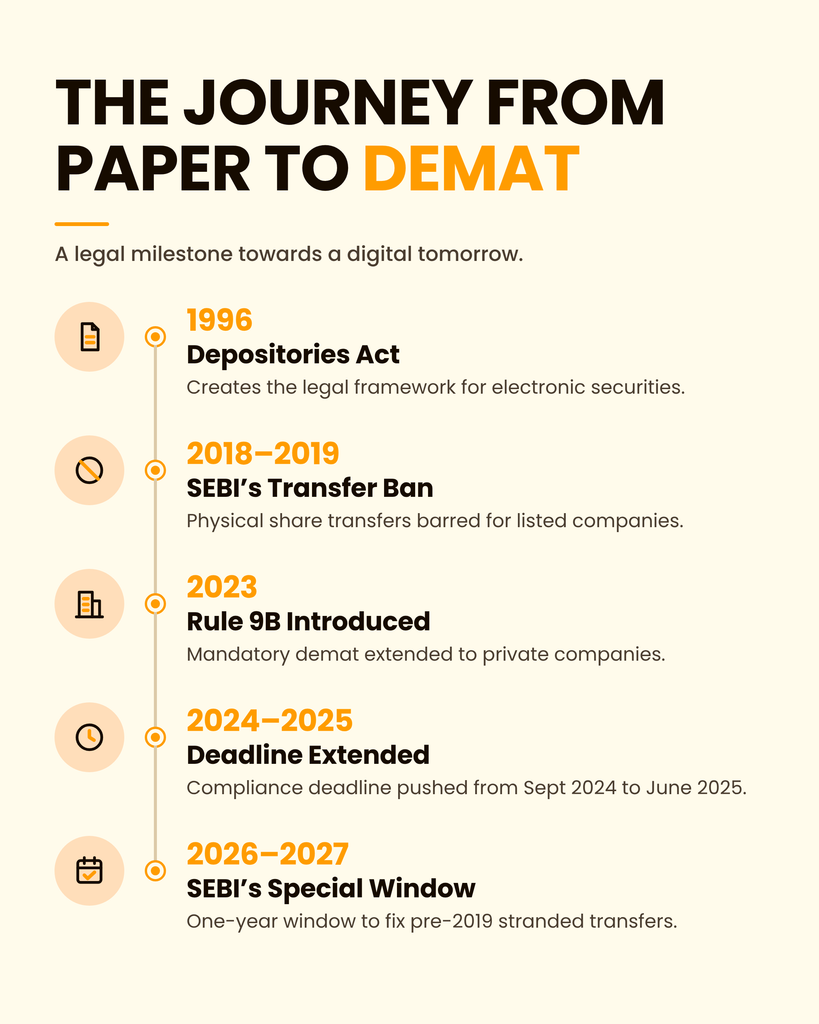
The policy change brought about by the legislature to address these deficiencies was the enactment of the Depositories Act, 1996 (the “1996 Act”). A depository, simply put, is an institution that holds securities in electronic form on behalf of investors, similar to how a bank holds money on behalf of depositors. Section 9(1) of the 1996 Act requires all securities held by a depository to be dematerialised and kept in fungible form, which means that individual share certificates no longer exist as distinct paper instruments and instead become interchangeable electronic entries.1 This provision enabled the National Securities Depository Limited (NSDL), and later the Central Depository Services Limited (CDSL), to serve as India’s two depositories, settling transfers electronically rather than physically moving paper.
However, the 1996 Act did not abolish physical shares. It established a parallel electronic system and left the decision to dematerialise totally to the shareholder.
Paper Stays, But Stops Moving: SEBI’s 2018-2019 Transfer Ban
For more than two decades, shareholders had sole discretion over whether to use paper or demat. That changed when the Securities and Exchange Board of India (SEBI) determined that the optional system was no longer serving its purpose. In June 2018, SEBI modified the SEBI (Listing Obligations and Disclosure Requirements) Regulations, 2015, to include a requirement under Regulation 40(1) that listed entities could no longer execute transfer requests for securities held physically.2
The distinction that lawyers must make here, and that clients frequently misunderstand, is that this was a restriction on transfer rather than holding. After April 1, 2019 (the deadline for implementation), a shareholder could hold on to physical certificates while still receiving dividends, voting rights, and other corporate perks.3 However, they lost the ability to sell, gift, or transfer those shares without first converting them to electronic form. So SEBI did not prohibit paper shares; rather, it froze them until they were dematerialised.
The Net Widens to Private Companies
Private companies were wholly exempt from these regulations for years following SEBI’s 2019 deadline, as the demat mandate was only applicable to listed companies. That changed on October 27, 2023, when the Ministry of Corporate Affairs (MCA) notified the Companies (Prospectus and Allotment of Securities) Second Amendment Rules, 2023, which inserted a new Rule 9B into the Companies (Prospectus and Allotment of Securities) Rules, 2014.4
Rule 9B mandated that all private companies, with the exception of minor companies, must issue securities exclusively in dematerialised form and facilitate the dematerialisation of all existing securities prior to issuing any additional shares or conducting any buyback, bonus, or rights issues. Existing private companies were required to comply by September 30, 2024.
From the perspective of a shareholder, a shareholder who possesses physical securities in a company that is subject to this rule is prohibited from transferring those securities and, more importantly, from subscribing to any additional securities issued by the company, such as bonus shares and rights issues, until their current holding is dematerialised, as per Rule 9B(4).
Source: Generated by the author using Perplexity AI
Still a Work in Progress
In practice, India’s transition from paper shares remains unfinished, nearly thirty years after the Depositories Act, 1996 first made dematerialisation feasible and nearly a decade after SEBI prohibited physical transfers for listed companies.
The private company extension is the clearest evidence of this. For a significant number of companies that have yet to obtain an ISIN, an appointed RTA, or shareholders who have surrendered their certificates for conversion, the original September 30, 2024 deadline under Rule 9B was deemed unfeasible. The MCA responded by extending the deadline until June 30, 2025. This date has also passed, and private companies that missed it are not in a grace period; they are in continuing default and are subject to the penalty provisions of the Companies Act, as no further extension has been notified.5
Even on the listed-company side, where the transition is far more mature, SEBI is still clearing up the gap of its own 2019 mandate- most recently through a special window running from February 2026 to February 2027, aimed at investors whose pre-2019 physical transfer requests were never completed.6
In its entirety, the picture that emerges is not one of a single reform that was concluded in a single year, but of a regulatory project that is still being constructed, statute by statute and deadline by deadline. The practical answer to the question “what happened to physical certificates” for a lawyer who is advising a client on shares, whether they are listed or private, held for decades or issued last year, is that they have not vanished. They have been made steadily more difficult to operate, and this pressure is not showing any signs of abating.
The story of physical share certificates is a good reminder: Company Law doesn’t stay static and knowing the section isn’t always enough.
If you’re a law student, young lawyer or aspiring corporate lawyer, learn how Company Law operates beyond the textbook with Lawctopus Law School’s Practical Aspects of Company Law course. Learn securities, share capital, corporate operations, ESOPs, Shareholders’ Agreements, NCLT procedures and more through practical exercises and assignments.
References
- Depositories Act, No. 22 of 1996, Sec. 9(1), India Code (1996). ↩︎
- Securities and Exchange Board of India (Listing Obligations and Disclosure Requirements) Regulations, 2015, reg. 40(1), Gazette of India (2015) (as amended June 2018). ↩︎
- SEBI, Transfer of Securities Only in Demat Form- Deadline Extended till April 1, 2019 (Dec. 3, 2018), https://www.sebi.gov.in/media/press-releases/dec-2018/transfer-of-securities-only-in-demat-form-deadline-extended-till-april-1-2019_41214.html. ↩︎
- Companies (Prospectus and Allotment of Securities) Second Amendment Rules, 2023, r. 9B, Gazette of India (Oct. 27, 2023). ↩︎
- Companies (Prospectus and Allotment of Securities) Amendment Rules, 2025, Gazette of India, Notification No. F.No. 1/21/2013-CL-V (Feb. 12, 2025); see also PwC India, Regulatory Insights: Dematerialisation Deadline for Private Companies Extended by MCA (Feb. 12, 2025). ↩︎
- SEBI, Circular No. HO/38/13/11(2)2026-MIRSD-POD, Ease of Doing Investment: Special Window for Transfer and Dematerialisation of Physical Securities (Jan. 30, 2026). ↩︎
About the Author
Ms. Soumya Chaturvedi is a Learning Manager at Lawctopus Law School and an ex-Associate at IndusLaw, where she worked in the Capital Markets team. A 2021 graduate of NLU Odisha, she has previously interned with leading law firms including LKS, DSK Legal, and L&L Partners.