
Imagine you’re a law student preparing for a moot court competition. You’re eager to win and show your legal skills, but there’s a crucial step: creating the perfect “moot court memorial.” What is that?
Read on to dive deep into the art of creating winning memorials that will impress judges and secure your team’s success.
Understanding the Basics: What Is a Moot Court Memorial?
Before we embark on the journey to crafting a winning memorial, let’s clarify what a memorial is in the context of moot court competitions. A memorial, also known as a written submission or brief, is a legal document that presents arguments, legal analysis, and authorities on behalf of one of the parties in a hypothetical case. It serves as the foundation for oral arguments during the competition.
Understand the Moot Problem Thoroughly
Once you’ve chosen your side, immerse yourself in the problem. Understand the facts, the applicable laws, and the issues at hand. Read and re-read the moot problem, highlighting key details and legal principles. This in-depth understanding will serve as the bedrock of your memorial.
This is also where legal research becomes important. If you are not sure about how to approach research for a moot, Understand Legal Research Using 5 Key Concepts explains how legal research is used in moots to identify the law and find authorities supporting a legal proposition.
Crafting the Perfect Memorial
With a solid foundation, you can now embark on crafting a winning memorial. Here are some practical tips and strategies to help you along the way:
1. Organize Your Arguments Effectively
Your memorial should have a clear and logical structure. Start with a concise introduction that outlines the issues and your position. Follow this with well-organized sections that address each issue separately. Ensure that each argument flows logically from the previous one.
For example, In a moot problem involving contract law, if the issues are breach of contract and damages, you might structure your memorial with separate sections for each issue. Under “Breach of Contract,” you would present arguments supporting your position, followed by a section on “Damages.”
2. Back Your Arguments with Authorities
Every argument you make in your memorial should be supported by legal authorities, such as statutes, case law, and academic sources. Ensure that you cite these authorities correctly. Judges are more likely to be swayed by well-researched and well-supported arguments.
Think if you’re arguing a point about freedom of speech in a constitutional law moot, you could cite any landmark Supreme Court decisions that support your position. This would make your argument weigh more.
3. Counter the Opposing Arguments
A strong memorial anticipates and addresses counterarguments. Consider potential weaknesses in your case and proactively respond to them.
Acknowledge and address the arguments that the opposing party is likely to raise. Anticipate counterarguments and refute them with strong reasoning and authorities. This will show your preparation and mastery of the subject matter and your ability to engage with opposing viewpoints.
You can also read 10 Simple Rules To Start Reading Case Files Efficiently for practical guidance on understanding case materials and anticipating the opposing side’s arguments.
4. Draft with Precision and Clarity
Your memorial should be concise, precise, and free from grammatical errors. Avoid verbosity and ensure that your arguments are clear and to the point. Use headings, subheadings, and bullet points to enhance readability.
Instead of writing a long paragraph to explain a legal doctrine, break it down into bullet points for clarity.
For example:
- Doctrine of Promissory Estoppel
- Definition
- Elements
- Case Examples
5. Edit and Proofread
Never underestimate the importance of editing and proofreading. Typos and grammatical errors can detract from the professionalism of your memorial. Review it multiple times, and if possible, have a peer or coach review it as well.
Imagine submitting a memorial with the phrase “principal of law” instead of “principle of law.” Such errors can have a very negative impact on your presentation.
You can also read 10 Simple Rules To Start Reading Case Files Efficiently for practical guidance on understanding case materials and anticipating the opposing side’s arguments.
6. Polish for Perfection
Once you’ve crafted the initial draft of your memorial, it’s time to polish it for perfection. Here are some additional tips to elevate your memorial to a winning level:
Seek Feedback
Don’t hesitate to seek feedback from your moot court team, seniors, or professors. They can provide valuable insights and suggestions for improvement.
A team member may notice that your argument structure could be more logical, or your teacher might suggest a stronger case citation for a critical point.
Be Concise
In legal writing, less is often more. Try to convey your arguments and ideas concisely and clearly. Remove any unnecessary words or phrases that do not add value to your arguments.
Instead of writing, “In the event that the complainant chooses to withdraw the case voluntarily…”, just write “If the complainant voluntarily withdraws the case…”.
Practice Oral Advocacy
Your memorial should serve as the foundation for your oral arguments. Practice presenting your arguments orally to refine your delivery and ensure that your written submissions turn effectively into persuasive spoken arguments.
A Winning Memorial
Cover Page:
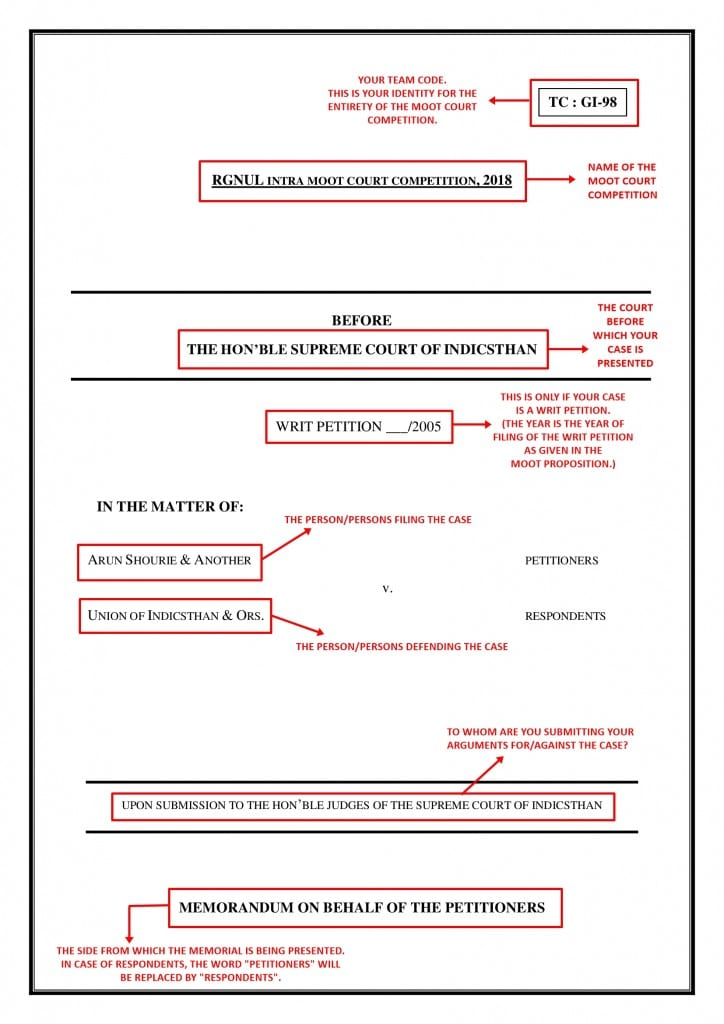
Image 1: Sample cover page of a moot court memorial
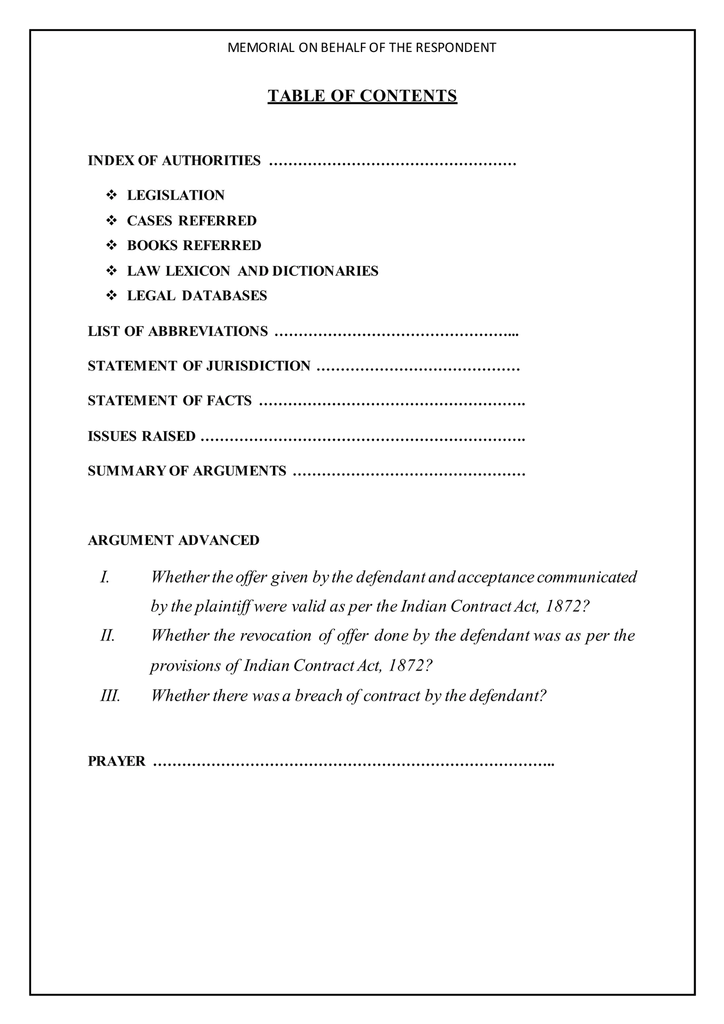
Image 2: Sample Table of Contents
To illustrate these tips in action, let’s consider a hypothetical scenario involving a human rights moot court competition. Your team is tasked with preparing a memorial on a case involving freedom of expression.
List of Abbreviations
Provide a handy reference for commonly used legal abbreviations, to ensure clarity and ease of reading.
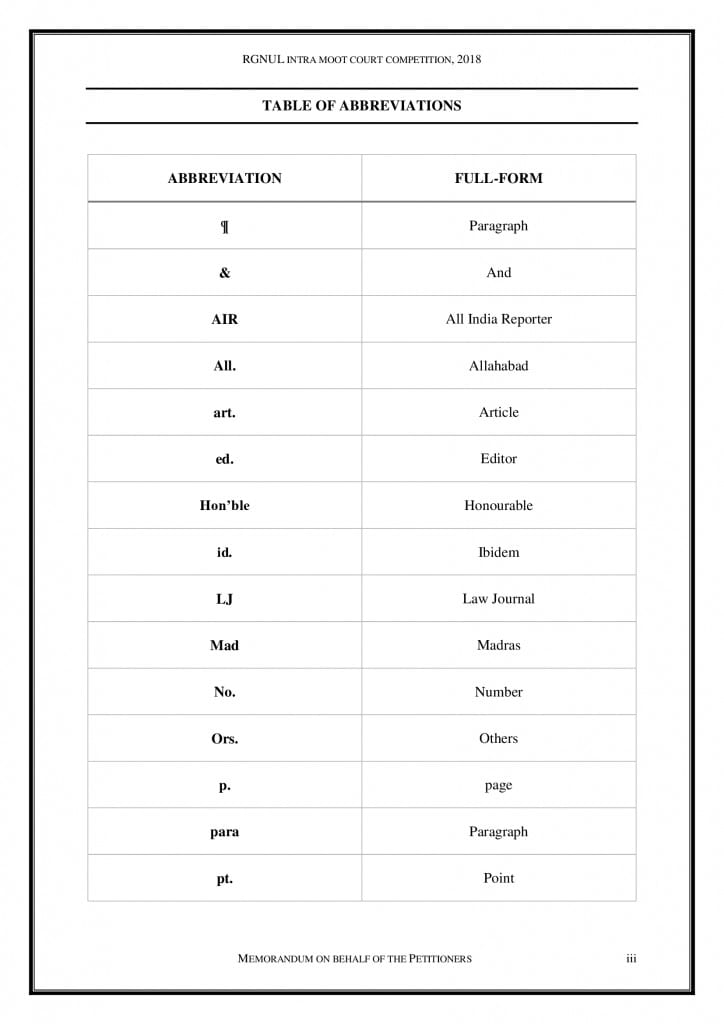
Image 3: Sample List of Abbreviations in a moot court memorial
Index of Authorities
Compile a list of legal sources and cases cited within the document to enable judges to locate references quickly.
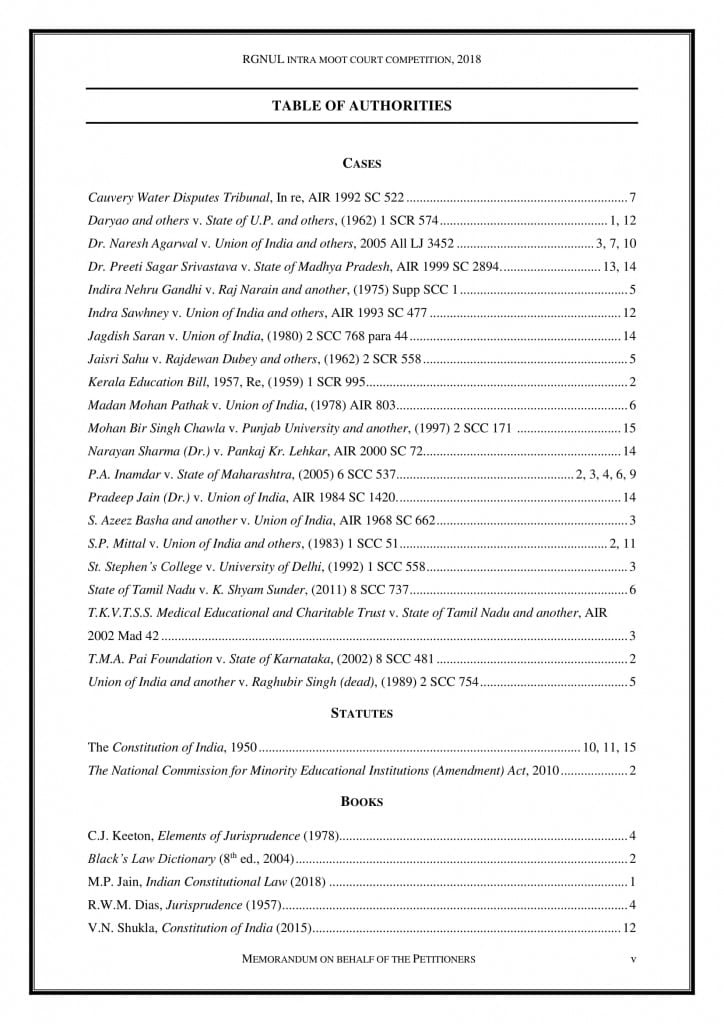
Image 4: Sample Index of Authorities
Statement of Jurisdiction
Here you will clarify the court’s authority to hear the case, specifying the legal basis and relevant laws that grant jurisdiction.
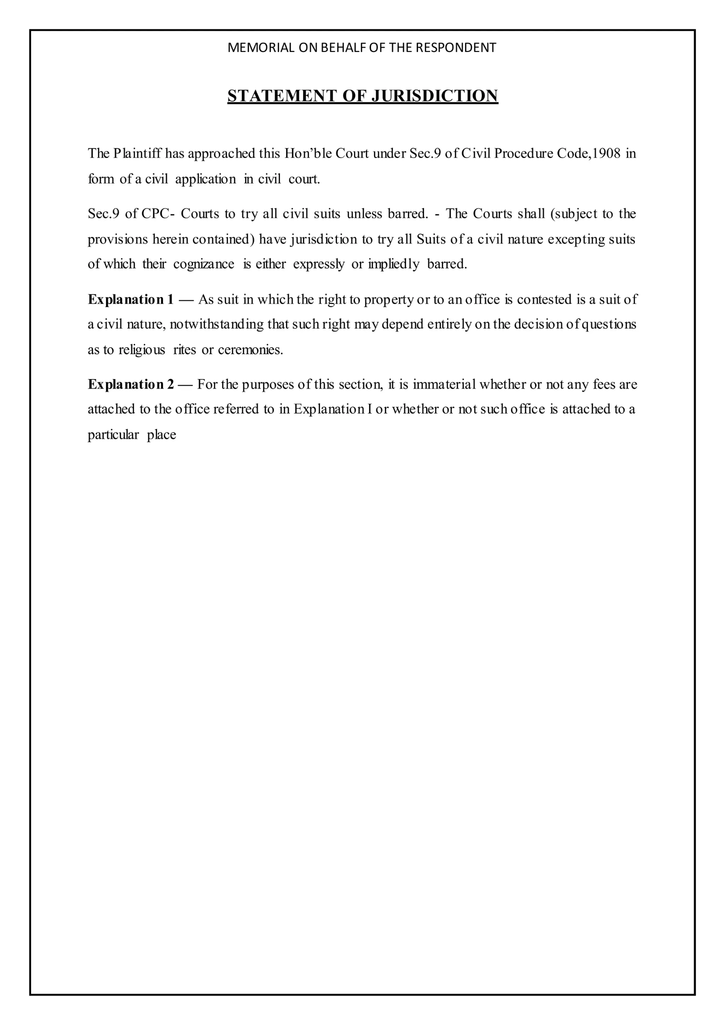
Image 5: Sample Statement of Jurisdiction
Facts of the Case
Begin with a concise introduction that provides an overview of the case, the key legal issues, and the position your team will be advocating.
Statement of Issues
List the legal issues that need to be addressed. In our case, these might include issues related to restrictions on freedom of expression, prior restraint, and the balancing of competing rights.
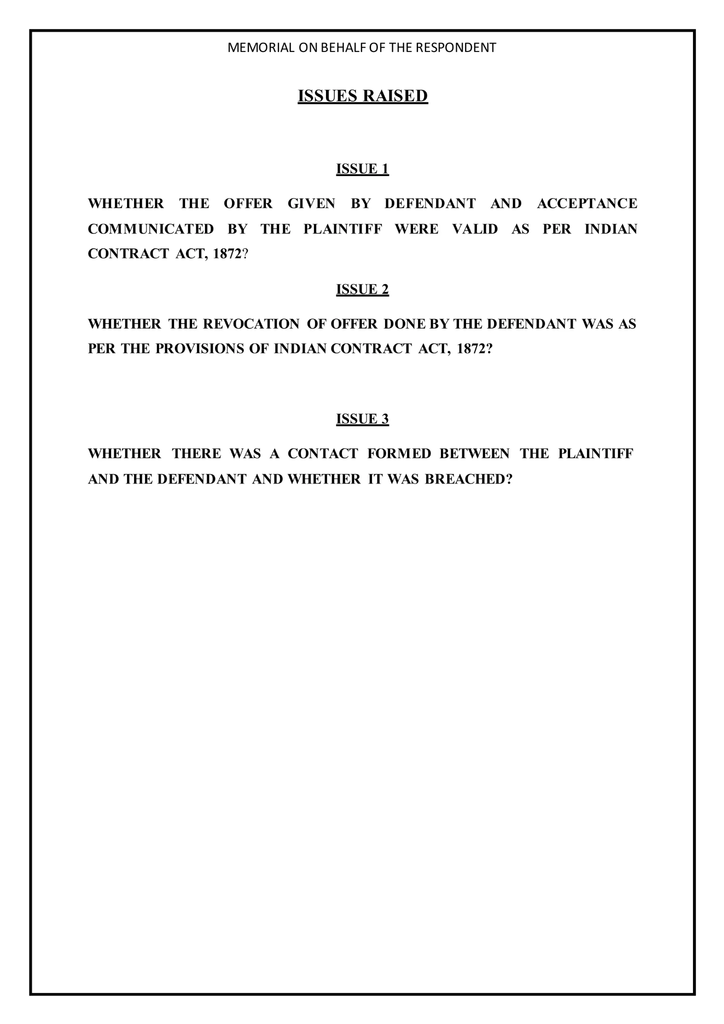
Image 6: Sample Statement of Issues setting out the legal questions
Arguments
Argument 1: The Right to Freedom of Expression
Start with a defense of the right to freedom of expression, citing relevant legal provisions and international human rights conventions.
Case Law: Reference to landmark cases where freedom of expression was upheld.
Argument 2: The Limits of Freedom of Expression
Acknowledge that the right to freedom of expression is not absolute. Explore cases where courts have recognized the need for restrictions in certain circumstances.
Case Law: Cite cases that demonstrate the principle of reasonable restrictions on freedom of expression.
For additional guidance on structuring legal arguments, Legal Writing Made Easy: How to Structure Like a Pro is a useful resource.
Conclude your Arguments
Summarize your key arguments and restate your position. Conclude by emphasizing the importance of upholding freedom of expression while recognizing the need for reasonable restrictions.
For guidance on making your legal writing more accurate, clear and authority-backed, read Become an Effective and Trusted Legal Writer by Following the 7 C’s of Legal Writing.
Prayer Clause
Here you will formally request the court to grant the relief or remedy you are seeking on behalf of your client.
Creating winning memorials for moot court competitions is a complex task. It requires a thorough understanding of the problem, careful research, effective organization, precise writing, and meticulous editing. With these tips and strategies, you can create memorials that impress judges, stand up to scrutiny, and pave the way to victory in moot court competitions.
Remember, practice makes perfect, so develop your skills and aim for excellence in every aspect of moot court competition preparation.
But reading about mooting is only the beginning. To become a confident mooter, you need to put these skills into practice: from analysing the proposition and conducting legal research to drafting your memorial and presenting your arguments before the judges.
Want to go beyond writing a moot memorial? Writing a good memorial is only one part of mooting.
You also need to know how to analyse a moot proposition, conduct focused legal research, build persuasive arguments, anticipate questions, respond to the opposing side and present your case before the judges.
If you want hands-on guidance through the complete mooting process, explore Lawctopus Law School’s Moot Course (& Competition).
Take what you have learned from this article and put it into practice. Good luck!
About the Author
Ms. Mansi Mankotia holds a B.A. LL.B. and LL.M. from HPNLU, Shimla. She secured AIR 906 in CLAT PG 2020 and is currently a Senior Learning Manager at Lawctopus Law School.