
This blog/article is written by Aarushi Relan, Learning Manager at Lawctopus Law School
Introduction
If you have ever wondered who owns a song’s copyright once an artist signs with a label, Taylor Swift spent six years in the public without filing a single lawsuit. She lost the master recordings to her first six albums in a corporate acquisition. She re-recorded four of them. In May 2025, she bought the originals back from Shamrock Capital for an undisclosed nine-figure sum.1
Most coverage read this as a celebrity feud or a contract related issue. Every move in it including the acquisition, legality of the re-recordings, the buyback and so on runs on doctrine that a transactional IP lawyer applies on an ordinary working day.
A song is not one copyright but has various elements
This is where most explainers go wrong. A recorded song stacks several rights on top of each other. The lyrics are a literary work authored by the songwriter. The composition is a musical work authored by the composer. The sound recording as per Section 2(xx) of the Copyright Act, 1957 (‘the 1957 Act’), is a recording from which sounds may be produced, regardless of the medium.2 The performance is protected in India as a distinct performer’s right under Sections 38 to 38B of the 1957 Act3. So you can write every word and note of a song and hold nothing in the final or master recordings (‘masters’) of it.
That was Swift’s position exactly. She wrote the early catalogue and Big Machine financed the recordings and owned those masters. When Ithaca Holdings acquired Big Machine in 2019, the masters went with the company. Ithaca sold on to Shamrock Capital in 2020, at a price variously reported between $300 million and $360 million.4 Nothing about that was unlawful. It was a simple sale of an asset, one that happened to be Taylor Swift’s hard work, her creation and her voice.
The Re-recordings: The loophole is old and part of Copyright law
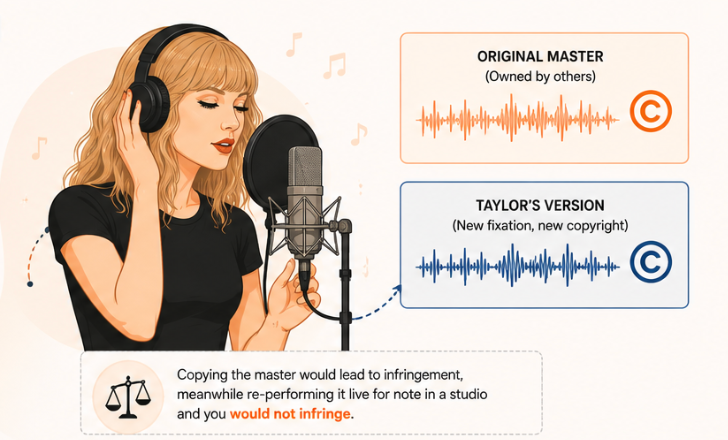
Image generated by OpenAI
Image 1: Copying a master infringes, re-performing it does not
Swift needed nobody’s permission to make new recordings, for two reasons. Firstly, she controlled the compositions so she could license fresh fixations of her own songs and each new fixation is a new sound recording with its own copyright. Secondly, under 17 U.S.C. §114(b), the rights of a sound recording owner do not extend to another recording that consists entirely of an independent fixation of other sounds, even where it deliberately imitates the original.5 Copy the master and you infringe. Re-perform it, note for note, in a studio and you do not.
The only obstacle she faced was contractual, not statutory. Recording agreements carry a re-recording restriction clause which states that an artist cannot re-record the delivered tracks for a fixed period after the term ends. Fortunately, she was able to overcome this obstacle since that period had lapsed.
Devaluing an asset you do not own
Image 2: The success of Eras Tour helped Taylor Swift buyback old masters owned by others
Taylor Swift is blessed with a true fan following popularly called Swifties. Fearless (Taylor’s Version) and Red landed in 2021, following with Speak Now and 1989 in 2023.6 Her loyal Swifties swiftly shifted their preferences to Taylor’s version and had a valid reason to switch. Every playlist swap and sync license that moved to the new recordings pulled income away from the old masters quietly, depressing the value of the very asset the holder needed to monetise. The Eras Tour, which grossed an estimated $2.2 billion, paid for the buyback. She did not litigate but competed with herself and won.7
The exit route she did not use and necessary clauses
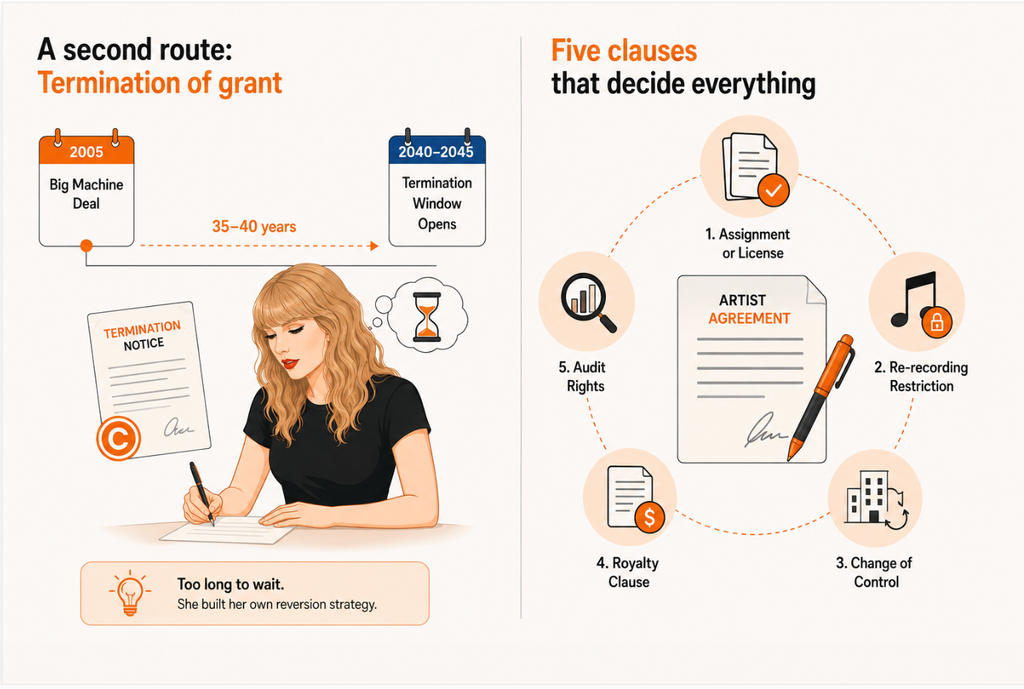
Image 3 – The necessary clauses in an Artist Agreement
US copyright law offers authors a second route. Section 203 lets an author terminate a grant executed on or after January 1, 1978, effective 35 years after execution, within a five-year window on advance written notice and it cannot be contracted away.8 Her Big Machine deal dates from 2005 allowing the termination window being open 35 years from execution between 2040 to 2045. But there is another catch worth knowing that most explainers skip. Termination under Section 203 does not apply to work made for hire and label agreements routinely characterize sound recordings as work made for hire. Whether that characterization holds for a sound recording is genuinely contested in the US. Thus, Swift’s alternative was a long waiting time. Instead, she engineered her own reversion out of a contractual gap.
A lesson to learn from this is that five clauses decide everything in an artist related contract. Firstly, whether it is an assignment or a license. Under Section 19(1) of the 1957 Act, an assignment must be in writing and signed and should identify the work, the rights, the duration and the territory.9 The re-recording restriction must always be negotiated, especially where the period is unreasonable. Swift’s whole strategy existed because hers ran out. There must be analysis of change of control since her masters were reallocated twice through corporate transactions she was not even a party to. Well-defined royalty and audit clauses are also an integral part of the artist’s agreement.
Could this have happened in India?
Partly, and the outcome for the songwriter would have been better. The 2012 amendment10 changed the position for authors of underlying works. The proviso to Section 1811 says that an author of a literary or musical work cannot assign away the right to receive royalties for use of that work in a sound recording, except to legal heirs or a copyright society. Sections 19(9) and 19(10) void any assignment that denies the author an equal share of royalties for utilisation of the work in any form other than communication to the public along with a film in a cinema hall.12 So, perhaps an Indian Swift would still likely not own the masters but she would keep royalty stream from the composition inside it.
Swift did not win because she owned her songs. She won because she owned her compositions and because somebody in 2005, gave the re-recording restriction an expiry date. Copyright did not save her, but drafting did.
And that is the real lesson for an IP lawyer: knowing the law is only half the job; knowing how to structure the deal is what protects the client.
If you want to build practical expertise in IP law, copyright contracts, assignment and licensing, explore Lawctopus Law School’s Intellectual Property: Law & Practice course.
Want to build practical IP skills? Call +91 93596 84056 for a free course/career counselling call or write to courses@lawctopus.com.
References
- Chris Willman, Taylor Swift Shocker: Singer Buys Back Rights to First Six Albums – Even as ‘Reputation Taylor’s Version)’ ‘Can Still Have a Moment to Reemerge’ Later, VARIETY (Aug 31, 2026, 5:30 PM), https://variety.com/2025/music/news/taylor-swift-buys-rights-first-six-albums-shamrock-1236413964/. ↩︎
- The Copyright Act, No. 14 of 1957, Section 2(xx), India Code (1957). ↩︎
- The Copyright Act, No. 14 of 1957, Sub-section 38-38B, India Code (1957). ↩︎
- Marc Schneider, Taylor Swift buys back her masters from Shamrock, reclaiming her first six albums, BILLBOARD, (Aug 31, 2026, 7:08 PM), https://www.billboard.com/pro/taylor-swift-regains-control-master-recordings-shamrock/. ↩︎
- 17 U.S.C. Section 114(b) (2018). ↩︎
- Alison Durkee, Taylor Swift Announces ‘1989 (Taylor’s Version)’ Album Onstage At ‘Eras’ Tour, FORBES (Sept 1, 2026, 2:54 PM) https://www.forbes.com/sites/alisondurkee/2023/08/10/taylor-swift-announces-1989-taylors-version-album-onstage-at-eras-tour/. ↩︎
- Nicolas Vega, Taylor Swift now owns all her music thanks to her $2 billion Eras Tour, CNBC (Sept 1, 2026, 12:54 PM) https://www.cnbc.com/2025/05/30/taylor-swift-now-owns-all-her-music-thanks-to-her-2-billion-eras-tour.html. ↩︎
- 17 U.S.C. Section 203 (2018). ↩︎
- The Copyright Act, No. 14 of 1957, Section 19(1), India Code (1957). ↩︎
- The Copyright (Amendment) Act, No. 27 of 2012, India Code (2012). ↩︎
- The Copyright Act, No. 14 of 1957, Section 18, India Code (1957), as amended by The Copyright (Amendment) Act, No. 27 of 2012. ↩︎
- The Copyright Act, 1957, Section 19(9) and 19(10), No. 14, Acts of Parliament, 1957 (India). ↩︎
About the Author
Aarushi Relan is an Intellectual Property and Technology Law practitioner with 5+ years of experience. She holds a B.Com. LL.B. (Hons.) from Amity University and an LL.M. in International IP and Technology Laws from the University of Cambridge. She is currently a Learning Manager at Lawctopus Law School, specialising in Trademarks, Copyright and Technology Law.