
WhatsApp screenshots as evidence in India can help establish what was said in a conversation. But can you simply print a chat and submit it in court? Not necessarily. Digital evidence must be assessed for its source, context, authenticity and compliance with the law.
WhatsApp Screenshots as Evidence in India: Can They Prove Your Case?
A screenshot captures how a conversation appeared on a screen. The underlying conversation stored on a phone or other system may contain context or metadata that the image does not show. It may, for example, reveal what was said before and after a disputed message.
A screenshot does not prove its own authenticity. A saved contact name may not establish the real-world identity of the account user, and a cropped image may omit messages that change the meaning of an exchange.
Can WhatsApp screenshots be used as evidence in Indian courts? They may be relied upon, subject to the rules governing electronic records and proof. The process depends on whether the material is an original record, screenshot, exported conversation, printout or another computer output.
When relying on WhatsApp screenshots as evidence in India, preserve the screenshot and, wherever possible, the original device or electronic record. The aim is to establish the source, context and reliability of the material.
What Does Indian Evidence Law Say About Digital Records?
The Bharatiya Sakshya Adhiniyam, 2023 (BSA), in force from 1 July 2024, governs proof of evidence in proceedings to which it applies. Three provisions are particularly relevant.
Section 61: Electronic or digital records
Section 61 recognises electronic and digital records and says they cannot be denied legal effect or admissibility merely because they are electronic. The recognition remains subject to the Act’s other requirements.
Section 62: Special provisions relating to electronic records
Section 62 provides that the contents of electronic records may be proved in accordance with Section 63.
Section 63: Admissibility of electronic records
Section 63 sets conditions for admitting specified electronic outputs, including copies and printouts. These concern regular use of the device, ordinary-course input, proper operation and how the output was produced.
Put simply, Section 61 recognises electronic records, Section 62 directs how their contents are proved, and Section 63 sets out conditions for admitting relevant outputs. Printing a chat or attaching a screenshot to a pleading does not, by itself, resolve admissibility or authenticity. This distinction matters whenever WhatsApp screenshots are presented as evidence.
Admissibility and evidentiary weight are different. Even an admitted record may be questioned for reliability, context or significance. For help locating and analysing legal materials, see LLS Magazine’s article Legal Research 101: A Beginner’s Guide to Legal Research. It offers a useful starting point.
Those who want structured practice in legal research and writing can explore Lawctopus Law School’s Certificate Course on Legal Research and Writing.
The Certificate Under Section 63(4)
Section 63(4) of the BSA prescribes a certificate for electronic evidence tendered as a computer output under Section 63. The certificate addresses the record, how it was produced and relevant particulars of the device or system.
The Schedule divides the certificate into Part A and Part B. Part A records details about the electronic record and its source or device; Part B contains the expert component. The form also requires the hash value and algorithm used.
What is a hash value?
A hash value is a digital fingerprint generated from data. It can help check whether examined data matches the data associated with that value. It does not prove who sent a message or whether its contents are true.
In Pune Bar Association v. Union of India, W.P. (C) No. 599 of 2026, order dated 22 May 2026, the Supreme Court discussed hash values and expert certification and did not find the Section 63(4) requirements manifestly arbitrary or unreasonable. It discussed who may certify Part B but left that legal question open.
Consider the certificate when collecting evidence, not as a last-minute formality. Identify the source and device, preserve the record and obtain technical assistance where needed. The precise requirements depend on how the record is produced and tendered; a certificate does not cure every defect.
How to Cite Faster: Get Your Citations Right the First Time & Always
How to Preserve WhatsApp Screenshots as Evidence in India

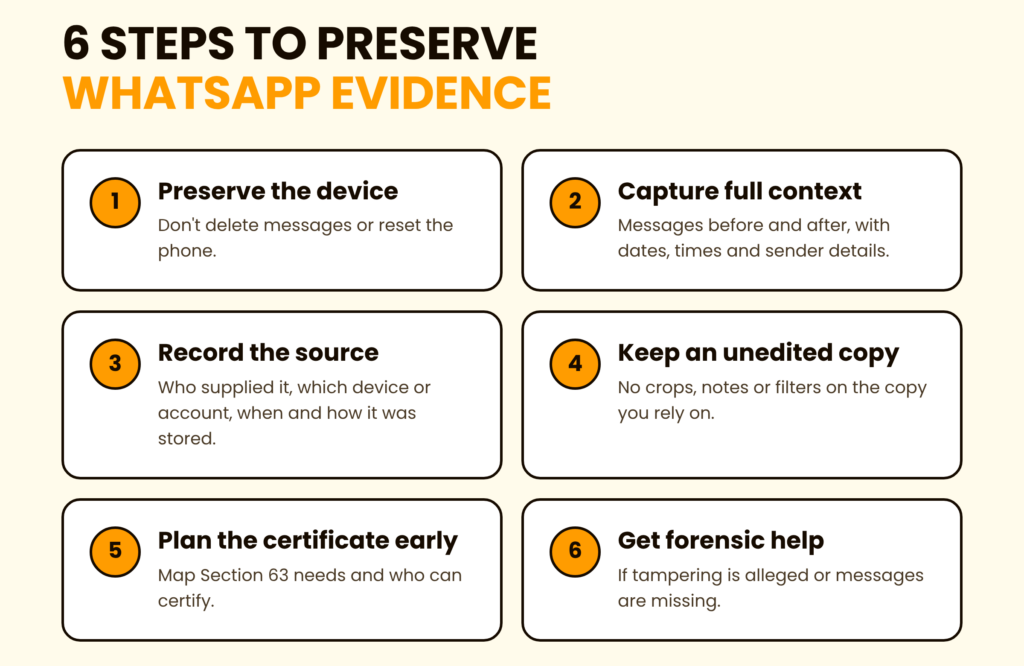
Image 1: 6 steps to preserve WhatsApp screenshots as evidence in India
Imagine preparing a breach-of-contract case. Your client sends 15 WhatsApp screenshots, but messages are missing, the contact is saved under a nickname and the phone has been reset. These gaps may make the evidence difficult to verify.
- Preserve the original device and record: Avoid deleting messages, resetting the phone or making changes that may affect available data. Retain access to the original conversation wherever possible.
- Capture the full context: Keep relevant messages before and after the disputed statement, along with dates, times and available sender details. Do not rely only on a cropped image.
- Record the source: Note who supplied the material, which device or account it came from, when it was collected and how it was transferred or stored.
- Keep an unedited copy: Avoid cropping, annotating, filtering or modifying the only copy you intend to rely on. Preserve the original separately from any working copy.
- Consider the certificate early: Identify the requirements that may apply under Section 63 and determine who can provide the necessary information and certification.
- Seek forensic assistance if needed: Where tampering is alleged, messages have disappeared or authenticity is seriously disputed, a qualified digital-forensics professional may help examine the available material.
These steps do not guarantee admissibility; they preserve material that may help establish authenticity, integrity and context. Collection must also be lawful. Do not advise clients to hack accounts or access private communications without authority.
Evidence handling is only one part of case preparation. For practical guidance on organising case files, read LLS Magazine’s 10 Simple Rules to Start Reading Case Files Efficiently and Beyond the Bare Act: 7 Practical Skills for Young Criminal Litigators. Law students who want to understand court proceedings and work with bulky case files can also explore Lawctopus Law School’s Litigation Basics: Navigating Cases and Files.
What If the Other Side Says the Screenshot Is Fake?
If the other party denies sending a message, identify the precise dispute: sender identity, completeness, date and time, possible editing, or the meaning attributed to the message.
The original device may help establish context. Lawfully obtained account records or forensic examination may address identity, timing or alleged manipulation. Payment records, emails, contracts and testimony may also support or contradict the screenshot.
Arjun Panditrao Khotkar v. Kailash Kushanrao Gorantyal (2020) 7 SCC 1 considered Section 65B of the former Indian Evidence Act, 1872. It remains important for understanding the earlier law, but the BSA applies to proceedings governed by the new Act. Section 170 contains savings for specified proceedings pending immediately before commencement. Identify the applicable statute rather than applying Section 65B mechanically.
During cross-examination, ask who collected the screenshot, from which device, whether the original was preserved and how the copy was generated. For more guidance, read LLS Magazine’s article Cross Examination Before the Court: A Go-To Guide.
The Final Takeaway: Think Beyond the Screen
A screenshot may start an investigation; it should not end it. WhatsApp screenshots as evidence in India must be approached with legal research, careful preservation and compliance with the applicable procedure. When a client says a screenshot proves everything, check its source, preserve the underlying record and determine how it can be proved.
References
- The Bharatiya Sakshya Adhiniyam, 2023, ss 61-63, particularly s 63(4) and the Schedule.
- Arjun Panditrao Khotkar v. Kailash Kushanrao Gorantyal (2020) 7 SCC 1.
- Pune Bar Association v. Union of India, W.P. (C) No. 599 of 2026, order dated 22 May 2026.
- Information Technology Act, 2000, s 79A.
About the Author
Vishakha Girhe is a Learning Manager at Lawctopus Law School. She holds an LL.M. in Business Laws and has practised as an independent litigator at the Nagpur District Court and Bombay High Court, Nagpur Bench.


