
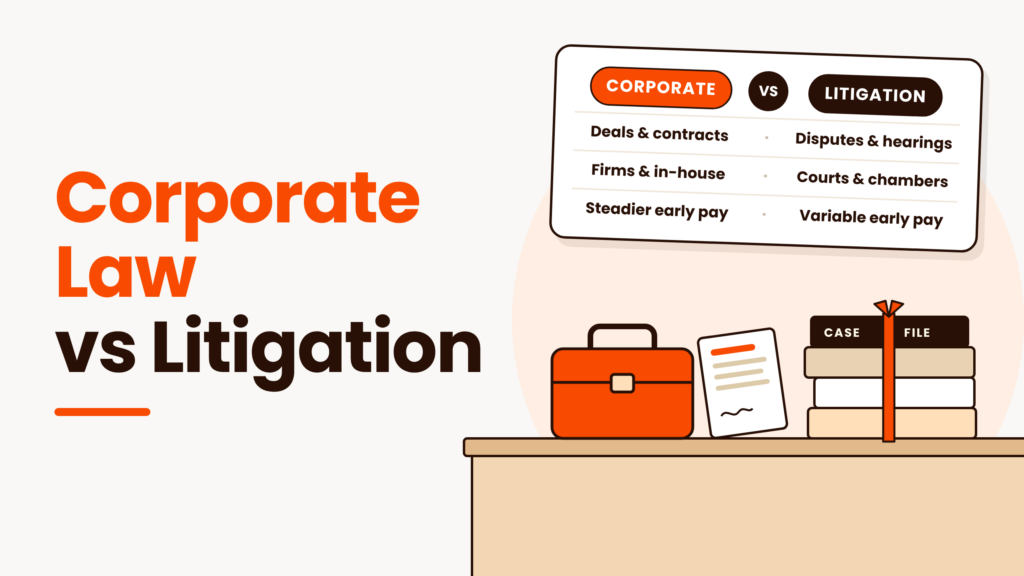
Corporate law vs litigation is a major decision for law students and recent LLB graduates. One path involves commercial transactions and advisory work; the other centres on disputes and advocacy.
Salary is only one factor. Your daily work, training, finances and preferred work environment matter too.
Corporate Law vs Litigation: What Is the Difference?
Corporate lawyers advise businesses on legal issues connected with their operations and transactions. Their work may include drafting and reviewing contracts, conducting due diligence, advising on company law and regulatory compliance, and supporting mergers and acquisitions (M&A), private equity or venture capital transactions.
Litigators represent clients in disputes. They may appear before courts, tribunals or arbitral forums; research legal issues; draft pleadings and applications; prepare briefs; and advise clients on dispute strategy.
For example, corporate lawyers may handle due diligence and transaction documents in an acquisition. If a dispute arises, dispute-resolution lawyers may advise and represent a party. The fields often intersect.
Key Differences Between Corporate Law and Litigation
| Factor | Corporate law | Litigation |
| Nature of work | Transactions, contracts and advisory | Disputes, pleadings and hearings |
| Work settings | Law firms and company legal teams | Chambers, litigation firms, courts and tribunals |
| Early income | Often more predictable at established firms | Can be modest or variable at the start |
| Work pattern | Deal deadlines and client demands | Court listings, filings and urgent matters |
| Core skills | Drafting, negotiation and commercial awareness | Research, procedure, drafting and advocacy |
| Progression | Associate, senior associate, counsel or partner; in-house roles | Growing responsibility and potentially independent practice |
Neither career guarantees an easier working life. Corporate lawyers face deal deadlines; litigators face court schedules and urgent filings. Conditions vary by employer and practice area.
Career Opportunities After LLB
If you choose corporate law
Roles exist in law firms, in-house teams, banks, startups and compliance teams. Practice areas include M&A, private equity, securities, insolvency, competition, technology, data protection and intellectual property.
For a closer look at company-side legal work, read In-House Counsel vs. Law Firm Job: What Should You Pick After Law School?.
If you choose litigation
You may work with an individual advocate or chamber, join a litigation-focused firm or gradually build an independent practice. Matters may be handled before District Courts, High Courts, the Supreme Court and specialised tribunals such as the NCLT or NCLAT, subject to applicable practice and appearance rules. Civil, criminal, constitutional and commercial disputes are possible areas. Arbitration and mediation offer related dispute-resolution opportunities, though they are not the same as court litigation.
For a practical account of early litigation work, see From Intern to Independent Practitioner: How to Build a Career in Litigation.
Salary Comparison: Corporate Lawyer vs Litigation Lawyer in India
Pay varies by employer or chamber, city, practice area, experience and recruitment route.
Graduates joining established corporate law firms may receive comparatively higher and more predictable starting compensation than many junior advocates. However, pay at smaller firms, boutique practices and in-house teams can differ considerably. With experience, lawyers may move into senior associate, counsel, partnership or in-house leadership roles; none is an automatic progression.
The early years of litigation can be financially difficult. Junior advocates may receive a stipend, fixed salary or matter-based payments, and arrangements vary between chambers and cities.
In a Lok Sabha answer dated 6 February 2026, the Ministry of Law and Justice stated that the Bar Council of India had recommended monthly stipend benchmarks of Rs. 20,000 for urban junior advocates and Rs. 15,000 for rural junior advocates. These are recommendations, not universal statutory minimum payments. See the official Ministry response.
Separately, the Supreme Court discussed a proposed Young Lawyers’ Professional Assistance Fund in Sarika Tyagi v. Union of India. Its 17 July 2026 order recorded that a meeting with States and Union Territories would be convened to discuss the proposed corpus. The matter remained pending in the latest order available on 26 October 2026; the fund should not be described as an operational nationwide scheme. Read the 19 June order, the 17 July order and the 26 October order.
Overall, corporate law generally offers more predictable starting pay, especially at established firms. Litigation income may be less predictable initially but can grow with expertise, client relationships and reputation. Compare actual opportunities and expenses rather than relying on broad salary claims.
Skills You Need to Build

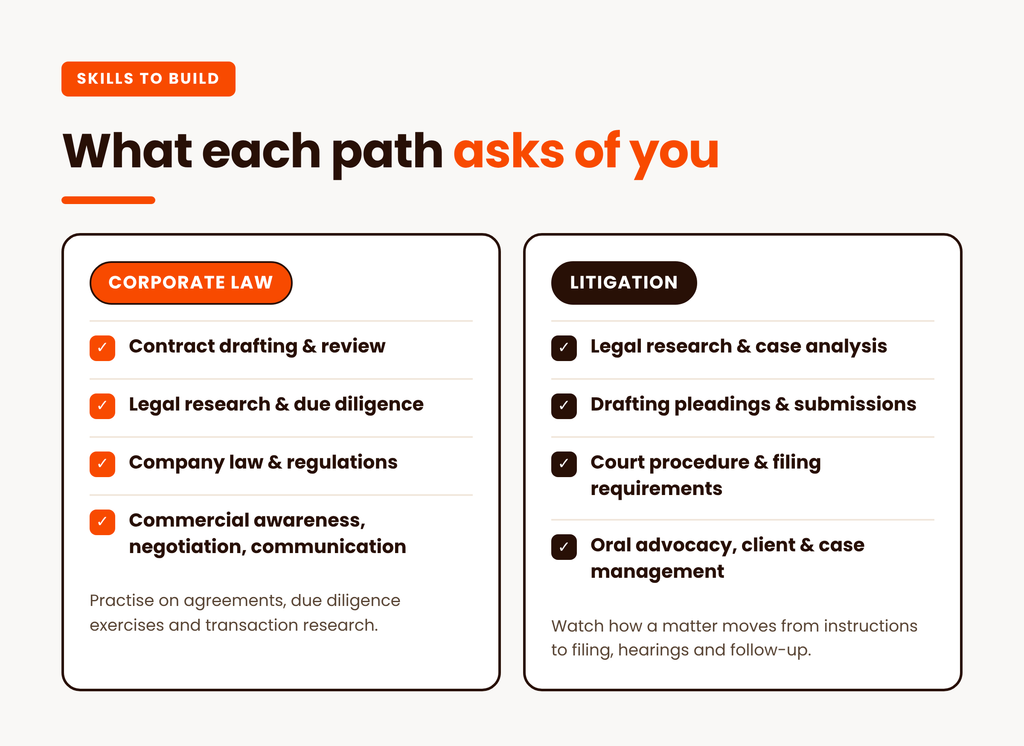
Image 1: Skills needed for corporate law and for litigation
For corporate law
- Contract drafting and review.
- Legal research and due diligence.
- Working knowledge of company law and relevant regulations.
- Commercial awareness, negotiation and clear communication.
Practical experience with agreements, due diligence exercises and transaction-related research can help you prepare.
Lawctopus Law School’s Contract Drafting and Negotiation course includes drafting and review exercises, negotiation practice and feedback.
For broader exposure, explore the Corporate Law Career Accelerator, covering areas such as M&A, SEBI regulations, IBC and corporate governance. Check the course page for current batch details.
For litigation
- Legal research and case analysis.
- Drafting pleadings, applications and written submissions.
- Understanding court procedure and filing requirements.
- Oral advocacy, client communication and case management.
Observe court proceedings and learn how a matter moves from client instructions to drafting, filing, hearings and follow-up. Reading judgments matters, but so does understanding case files and procedural steps.
Lawctopus Law School’s Litigation and Dispute Resolution Career Accelerator focuses on court practice, civil and criminal litigation, drafting and dispute resolution. Review the course page for the current curriculum.
Work-Life Balance: Which Career Is More Demanding?
Corporate lawyers may work late during deal closures and regulatory deadlines. A Vahura study of more than 1,450 professionals across over 300 Indian law firms reported concerns about long working hours and workplace stress. Published in 2022, it is a snapshot of that period, not a current measure of every firm. Read the Vahura Best Law Firms to Work Report 2022.
Litigators work around court schedules, filing deadlines, client meetings and urgent matters. Before accepting a role, speak to junior associates or advocates about hours, weekend expectations, mentorship and the assignments given to new entrants.
Can You Switch Between Corporate Law and Litigation?


Image 2: How lawyers can move between corporate law and litigation
Your first choice need not define your entire career. A corporate lawyer may move towards commercial disputes, arbitration or insolvency-related litigation. A litigator may develop skills in arbitration, contract advisory or legal consultancy, or apply for in-house roles.
Switching is possible but may require training and relevant experience. Courtroom practice needs procedural and advocacy skills; corporate roles require commercial drafting and regulatory knowledge.
How Should You Decide?

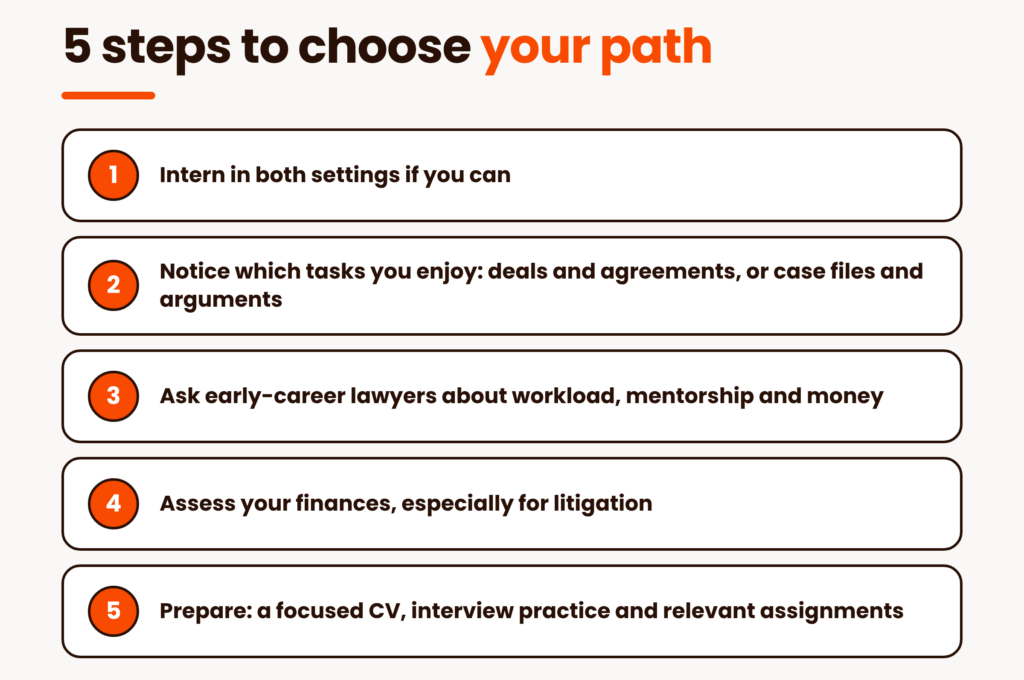
Image 3: 5 steps to choose between corporate law and litigation
- Intern in both settings if possible. Observe the work and speak to junior lawyers.
- Identify the tasks you enjoy: transactions and agreements, or case files and arguments?
- Speak to early-career lawyers about workload, mentorship and financial realities.
- Assess your financial circumstances, especially if you are considering litigation.
- Prepare for the role through a focused CV, interview practice and relevant assignments.
If you are considering a firm role, Lawctopus’ guide to careers in law firms, companies and litigation offers additional perspective.
Corporate Law vs Litigation: Which Career Should You Choose?
Corporate law may suit you if you enjoy business transactions, commercial agreements, regulatory work and advising organisations. Litigation may suit you if you are interested in disputes, court procedure, advocacy and building a practice.
Do not choose corporate law only because you have heard that it pays more, or litigation only because you enjoy debating. If possible, experience both through internships and practical assignments. Your first role is a starting point, not necessarily a lifelong commitment. Focus on sound training, good mentorship and skills that will remain useful if your interests change.
About the Author
Shatakshi Singh is a Legal Content Manager at Lawctopus. She has completed her LLM in Constitutional and Administrative Law from the ICFAI University, Dehradun. She is also a POCSO TTT Certified trainer.


