
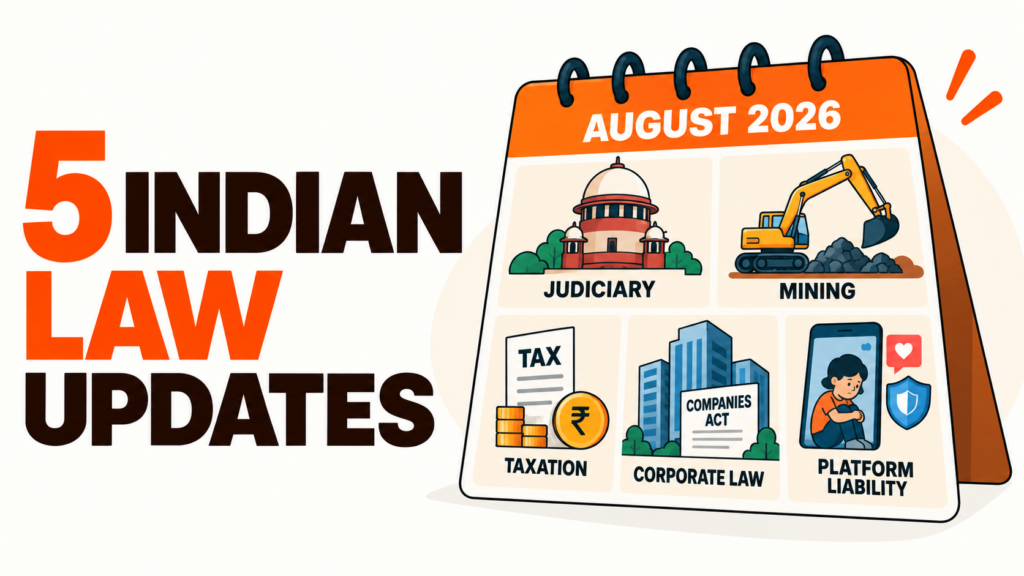
If you took a break from the news this August, here’s what you missed.
It was a busy month: a surprising course correction on judiciary exam eligibility, fresh amendments in mining, tax, and corporate law, and a ruling that pushes Indian courts further into the platform liability debate.
None of this is just trivia. This is the kind of thing that ends up in moot problems, viva questions, and current affairs sections of exams.
Here are the five updates worth actually knowing.
1. Supreme Court Softens the 3-Year Bar Practice Rule

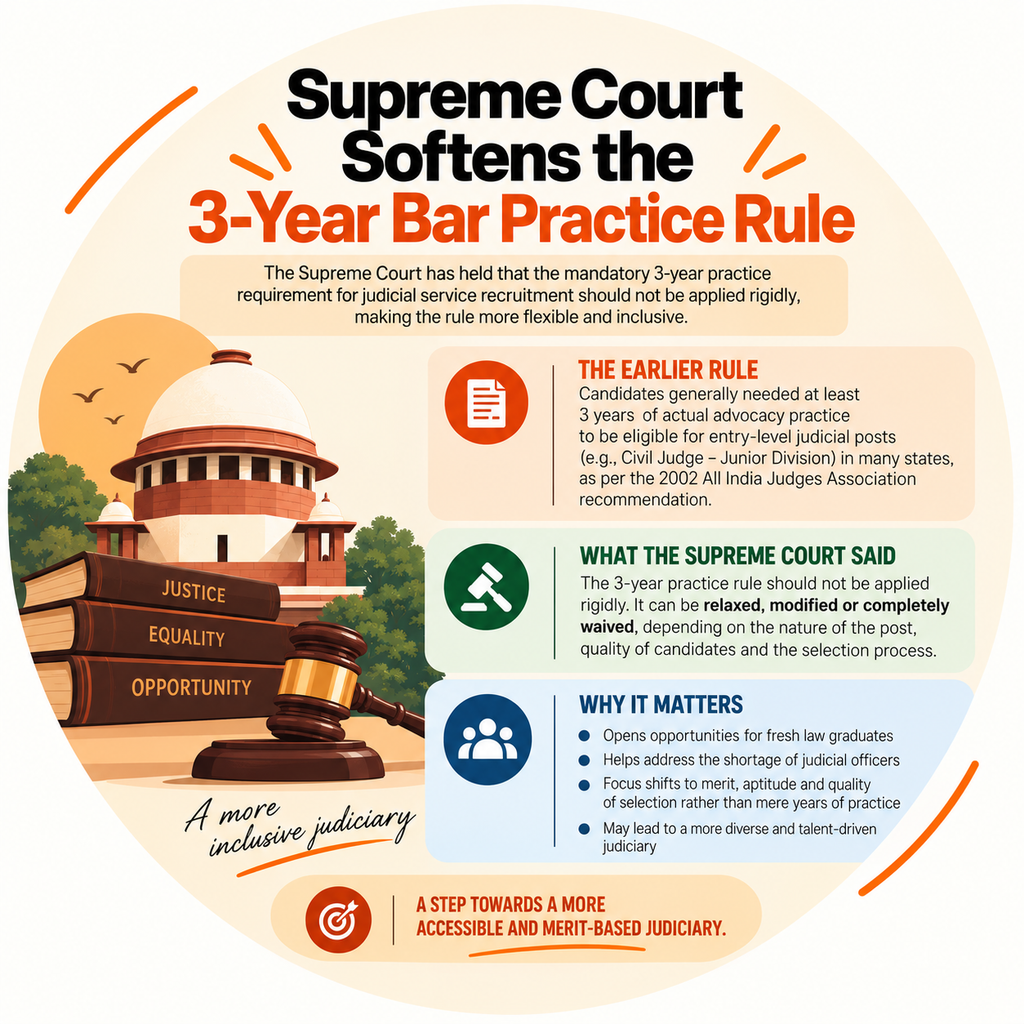
Image 1: SC eases the 3-Year Practice Rule
This is probably the biggest legal education story of the month.
On August 21, 2026, a Supreme Court bench led by Chief Justice Surya Kant (Justice Vinod Chandran dissented) modified its own May 2025 judgment in All India Judges Association v. Union of India. That earlier ruling had brought back a mandatory three year Bar practice requirement for anyone wanting to sit the Civil Judge (Junior Division) exam.
The May 2025 decision had genuinely shaken up judiciary aspirants. It undid a system that, since 2002, let fresh law graduates go straight from convocation to the judiciary exam hall. The August order doesn’t scrap that decision entirely, but it does soften it a lot.
Here’s the practical bit: the Court has drawn the line based on when a recruitment notification is issued, not when a candidate graduates.
- If the notification comes out before March 31, 2027, fresh graduates can apply with no prior practice at all. Think of it as a transition window for students who were mid-preparation while the rules kept shifting under them.
- If the notification comes on or after April 1, 2027, candidates will need at least one year of actual Bar practice, counted from provisional enrolment.
There’s also talk in the order of a hybrid model down the line: one year of Bar practice combined with structured judicial training and clerkship, as a way of building in real world exposure without locking graduates out for three full years.
If you’re in your final year of LLB, this genuinely changes your near term plans, so it’s worth reading the order itself rather than trusting whatever version is doing the rounds in your coaching centre WhatsApp group.
2. Mines and Minerals (Development and Regulation) Amendment Act, 2026
On August 17, the President gave assent to the Mines and Minerals (Development and Regulation) Amendment Act, 2026. It brings some real changes to how mineral rights and mineral bearing lands get regulated.
Mining law rarely makes it into casual conversation, but it sits right at an interesting constitutional fault line, between Entry 54 of the Union List, state royalties, and the long running argument over who actually benefits from natural resource revenue.
If you’re doing anything with federalism, natural resources, or environmental law electives, this amendment is a far more current example than the usual textbook cases.
It’s also good moot court material, mostly because it’s recent enough that nobody has written the definitive commentary yet. That gap is your opportunity.
3. Taxation and Other Laws (Amendment) Act, 2026
Also assented to on August 17, this Act reshapes a few corners of India’s tax and payments framework without making much noise about it. It touches the Payment and Settlement Systems Act, 2007, the Income Tax Act, 2025, and the Finance Act, 2026, and is treated as being in force from April 1, 2026 unless a provision says otherwise.
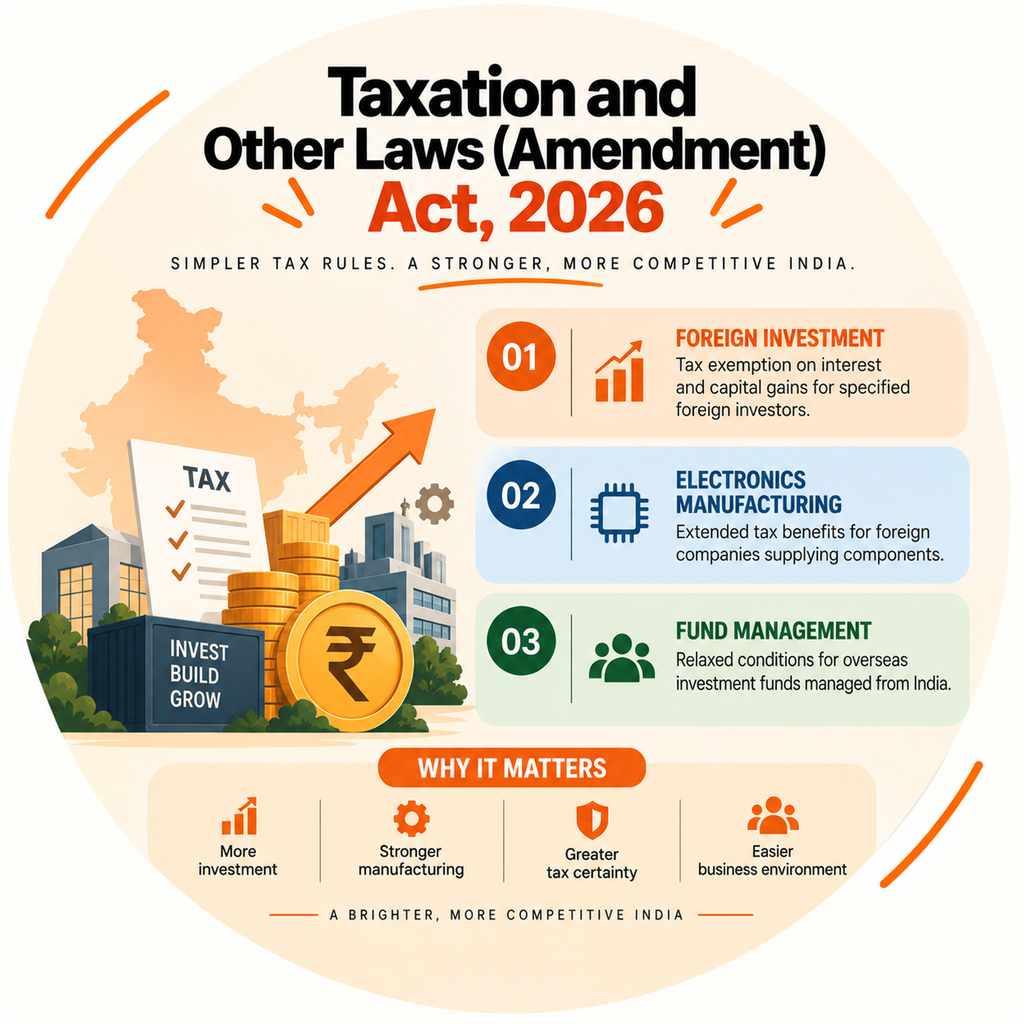
Image 2: Taxation and Other Laws (Amendment Act), 2026
A few of the headline changes:
- A revised safe harbour for foreign investment funds that use Indian fund managers, meant to make India a more attractive base for offshore fund management.
- Extended benefits for electronics manufacturing, continuing the government’s broader push in that space.
- Exemptions on government securities for certain categories of foreign investors.
- Some tax relief tied to bonded warehouse arrangements.
If tax law, banking law, or international finance is anywhere on your reading list, this gives you a cleaner and more current fact pattern than the double taxation hypotheticals professors love to recycle every semester.
4. Corporate Laws (Amendment) Bill, 2026 Clears a Key Hurdle
Company law students should take note of this one. The Joint Parliamentary Committee submitted its report on the Corporate Laws (Amendment) Bill, 2026 in early August, effectively backing the government’s proposed changes to the Companies Act, 2013 and the LLP Act, 2008.
What’s actually being proposed:
- A higher paid up capital and turnover threshold for what counts as a “small company,” which would ease compliance for a lot more businesses.
- Simpler routes for mergers and restructuring.
- Tighter audit oversight and stronger investor protection.
- Support for digital governance and sectors like GIFT City based financial services.
The Bill hasn’t been passed yet. It’s still making its way through Parliament, but a JPC endorsement is usually a strong sign that a bill is closer to becoming law than not. Worth keeping on your radar for the next update.
Exams in this area tend to ask what changed and why, and having the JPC’s own stated reasoning (less compliance burden, more governance) gives you a ready made way to frame an answer.
5. A Landmark Ruling on Platform Liability for Youth Mental Health
The month also brought a ruling holding Meta liable in a case concerning youth mental health. It sits right at the crossing point of three areas of Indian law that are all moving fast: data protection, child safety regulation, and intermediary liability under the IT Rules.
As lawsuits against social media platforms pick up pace globally, Indian courts are increasingly being asked to decide where “intermediary safe harbour” stops and actual liability begins. It’s a live and unsettled debate, and it’s likely to keep generating case law well into 2027.
If tech law, data protection, or media law interests you, this is worth following closely. It’s early enough in the conversation that a well argued analysis of it could genuinely shape how you approach related problems in class or in a moot.
The Takeaway
August 2026 was a month of course corrections and quiet groundwork.
The Supreme Court walked back part of its own ruling on judiciary eligibility, two Presidential assents reshaped mining and tax law, a corporate law bill moved a step closer to passage, and the courts sharpened the edges of platform liability.
None of these stories are finished. That’s exactly why they’re worth reading now, instead of waiting for the textbook version to catch up.
Don’t wait for these developments to become textbook material. Stay ahead by building practical, industry-ready legal skills. If you’re confused about which area to upskill in or where to begin, speak to the counsellors at Lawctopus Law School.
Call +91 93596 84056 for a free counselling call or write to courses@lawctopus.com.
About the Author
Ms. Varshni Krishnan holds a B.A. LL.B. and LL.M. from Amity University, Noida. She is a recipient of the prestigious Goolam E. Vahanvati Award, 2018 and currently works as a Legal Content Manager at Lawctopus.


